Reimagining Queer Solidarity: Sinophone Students and the Politics of Care in the UK
Article by Wei-An Chen
Abstract:
This article examines how queer Sinophone international students in the United Kingdom navigate (non)-belonging, care, and solidarity within and beyond local queer communities. Drawing on ten in-depth interviews with Chinese, Taiwanese, and Hong Kong students aged 19–27, it explores how they interpret and reimagine the notion of “queer community” through experiences of migration and marginality.
Participants described similar barriers to inclusion in mainstream queer spaces—such as university LGBTQ+ groups—ranging from subtle racialised assumptions of Asian passivity, to culturally coded “queer fashion” and “queer humour” that rendered their identities unintelligible, to the pressure of socialising in a non-native language and the feeling of tokenisation. Confronting these gaps, queer Sinophone students developed alternative networks of care and friendship rooted in shared vulnerability. Rather than seeking belonging solely through sexuality or gender identity, many formed close relationships with other peers who are also marginalized on multiple levels, including Latin American and Eastern European students, recognising in them resonant struggles with family pressure, shame, and social exclusion. These “minor-to-minor exchanges” (Liu & Li, 2025) reveal solidarity as an emotional and ethical practice rather than a fixed identity category.
Through this lens, the article contributes to debates on operationalising intersectionality in social justice and solidarity building. This research highlights an affective and cultural position that carries the potential to connect with other marginalised groups through shared experiences of vulnerability. In doing so, it situates these transnational acts of mutual care as a coalition of the stigmatized (Love, 2011) that challenges neoliberal resilience and redefines what solidarity can mean in times of precarity.
Keywords: Intersectionality; Queer; International Student; Community-Building; Solidarity
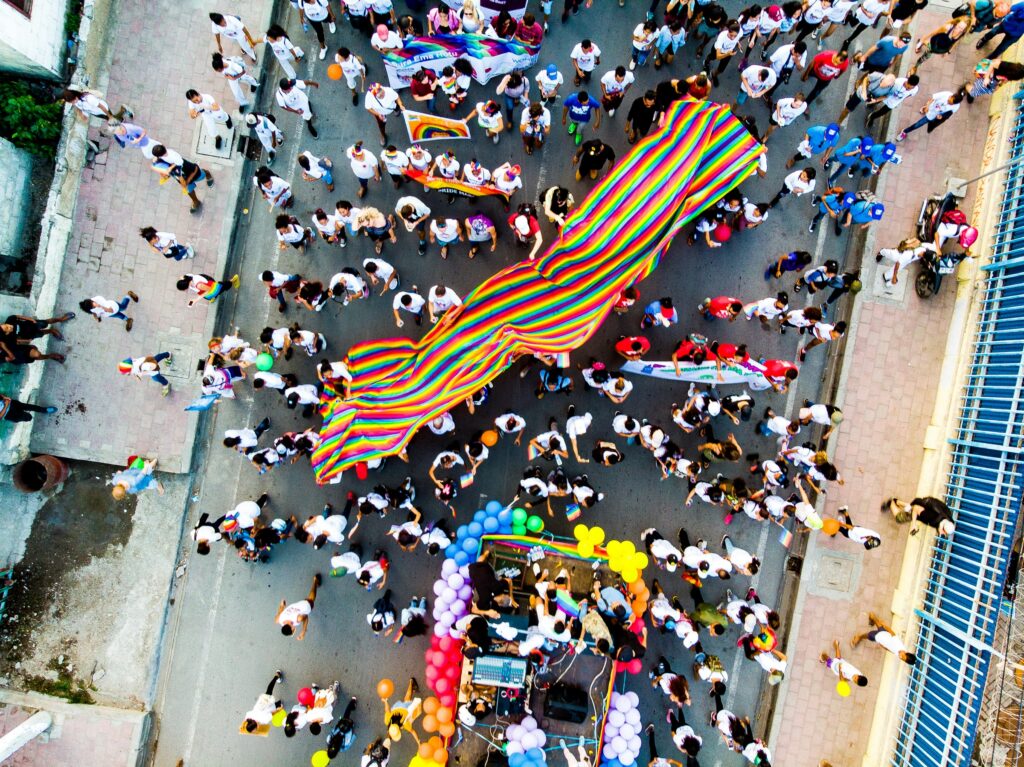
Header image “people standing on road” by Tanushree Rao is licensed under Unsplash License.
Introduction
This research investigates the identity of a community of queer international students (QIS) from Taiwan, Hong Kong, and China in the UK, and how they experience the cultural gap within UK-based queer communities, thus building an alternative network based on shared marginalized experiences. For example, Jay, a Chinese student studying for his master’s, shared his experience:
I sometimes make jokes related to my childhood trauma—not that it was anything extremely serious, but more like those difficult, tangled moments in life. But I’ve noticed that people [from the UK] often don’t get it and instead look shocked, saying things like, “Oh my god, that’s terrible! Are you okay?” Then the atmosphere suddenly becomes really awkward. I was trying to be funny, but everyone took it seriously, and it just made things even more uncomfortable […] I prefer to talk to less privileged girls or queer people, because they really get me.
From Jay’s experience of being an immigrant gay man, and from a conservative family, he is managing multiple identities that are unique and intersecting. Therefore, this research highlights how to capture intersectionality as a theoretical concept and an aspirational practice (Valocchi, 2005). However, the operationalisation of intersectionality as complex, irreducible positionalities, rather than simple additions of categories, has been a challenge (Collins, 2015; Collins et al., 2021). This study also views multiple identities as a dynamic process of identity management (Yang & Ghaziani, 2025). To construct such an approach to identities, this study focuses on the identity management of Sinophone queer international students in UK higher education (QIS), a rapidly growing community that has remained understudied in previous literature. QIS here refers to non-heterosexual and/or non-cisgender students studying abroad (Valosik, 2015), and Sinophone refers to Chinese-speaking societies and diasporas, such as Taiwan, Hong Kong, and overseas Chinese, each seen as culturally distinct (Shih, 2010).
This research contributes to inter-Asian studies by examining how cultural frameworks shared across Chinese-speaking societies—such as collectivist values, familial obligations, and distinct gender presentations—travel with and shape queer bodies in diaspora. These embodied cultural continuities enable Sinophone students to recognize resonant struggles across regional differences, generating alternative solidarity models that challenge Western individualist approaches to queer liberation.
Literature review
Feminist and queer studies have made important conceptual contributions to sociology, particularly through the introduction of intersectionality to understand how power structures such as racism, sexism, and heteronormativity co-construct distinct and inseparable forms of oppression. These axes are not simply additive, but instead constitute complex, irreducible positionalities. Rather than being positioned as a ‘totalizing theory of identity,’ intersectionality serves as a conceptual tool to analyze the fluid and structural dimensions of multiple identities (Collins, 1990; Crenshaw, 1991). However, the lack of a clear definition has made intersectionality difficult to operationalize, risking it becoming a “buzzword” and losing its critical edge (Collins, 2015; Collins et al., 2021). Based on this call, this research aims to further examine how the concept of intersectionality can contribute to solidarity and justice in relationship-building for the communities experiencing intersectional marginalization.
Furthermore, in practice, Love (2011) called for anti-normative politics of coalition, as a broader political act for queer people, the working class, people with disabilities and other marginalized groups, to construct a broader basis for resistance to oppression. From social movement studies, Van Dyke and Amos (2017) identified key conditions for coalition politics, including social ties, compatible organizational structures, ideological culture and identity, structural environments, and resources. They especially stressed that having the same political goals and effective communication strategies increases the likelihood of success. However, aside from formal social movement organization collaboration, this research aims to investigate how coalition building happens at an interpersonal, informal level, bringing the political to the interpersonal level.
Investigating the Sinophone QIS community helps in understanding the politics of coalition, because they are situated in an intersectional position, not only from their queer identity, but also because they must navigate cultural differences between their home country and the host country. Past literature has highlighted that queer East Asian international students often navigate tensions between collectivist values and filial piety, which are prioritized over individual desires in many home country contexts (Quach et al., 2013). Consequently, many students feel obligated to fulfil family expectations while struggling to assert their autonomy or experiencing a sense of “failure” (Hu & Flynn, 2022; Zheng, 2025). Moreover, queer international students often face isolation due to “double barriers” (Nguyen et al., 2017), where neither migrant nor queer communities fully understand their experiences. Some students report racial discomfort within predominantly White, mainstream queer communities, describing being seen as less desirable because of their ethnicity or stereotyped as quiet and submissive (Hu & Flynn, 2022; Le et al., 2022). Simultaneously, students also report needing to conceal their queer identities from other international students from similar backgrounds due to discrimination experienced in their home countries (Hu & Flynn, 2022; Cui & Song, 2024). Therefore, examining QIS experiences offers lived experiences of negotiating solidarity and care based on multiple minority identities.
Research Method
The research data is based on 10 in-depth interviews with QIS from Taiwan, Hong Kong, and China, conducted between April and May 2025. Participants were recruited through my social media and East Asian student online groups, with additional participants reached via snowball sampling. Each semi-structured interview lasted 40 to 80 minutes and covered topics such as mobility experiences, the exploration of sexuality and gender, social networks and community participation, and aspirations for queer solidarity.
The interviewees included three from Taiwan, two from Hong Kong, and five from China. All were currently enrolled in British higher education institutions, ranging from bachelor’s to PhD level, and were aged between 19 and 28. Of the ten participants, two identified as men, six as women, and two as non-binary. In terms of sexuality, all interviewees identified with non-heterosexual attraction, using terms such as gay, lesbian, bisexual, pansexual, or queer. The length of their stay in the UK ranged from nine months to seven years, and all were first-generation immigrants, with their families remaining in their home countries.
Findings and Analysis
This section will start with analysis of the barriers of Sinophone queer students in joining the UK queer community. Following this, I will elaborate on the alternative friendship network and the re-imagination of queer community by the participants, who all have multiple marginalized identities.
Barriers to Belonging: Racialized and Cultured Assumptions
Interviewees expressed that Asian queer bodies are often misread. While two interviewees reported overt racism in their surroundings, which echoes the “double barrier” situation in previous literature (Nguyen et al., 2017), it is more common that interviewees feel their queerness becomes invisible because of racialized assumptions and cultural mismatch.
Interviewees described a cultural mismatch in how queerness is read and how a queer community is expected to look, particularly for participants assigned female at birth (AFAB), due to racialised assumptions about Asian femininity (Pyke & Johnson, 2003; Keum et al., 2018). Four out of seven AFAB interviewees expressed insecurity about these gendered readings, citing them as a reason they struggled to find belonging in the UK queer community.
For instance, Ming described their identity as leaning towards “T” (butch in the Taiwanese context). However, they were described as heteropassing in UK queer spaces, which made it harder to navigate London’s queer scene. They attributed this to assumptions to the fact that East Asian bodies are more passive or docile, so what might be read as butch in Taiwan was instead perceived as straight in the UK. This illustrates a difference in the cultural toolkit for interpreting gender non-conformity: while UK queer communities encourage varied queer expressions, non-feminine presentation in AFAB that does not employ recognisable queer symbols or overtly androgynous cues may be rendered invisible. Similarly, Tess from China expressed frustration at being read as straight in UK queer spaces, which pressured her to present herself as more androgynous or expressive, even though this was not her preferred style:
“I try to put like a rainbow pin on my bag and people just say, ‘Oh, so you’re an ally,’ because I look too straight. And yeah, that’s the issue. So I sometimes feel this need to blend into this culture, to dress like others.”
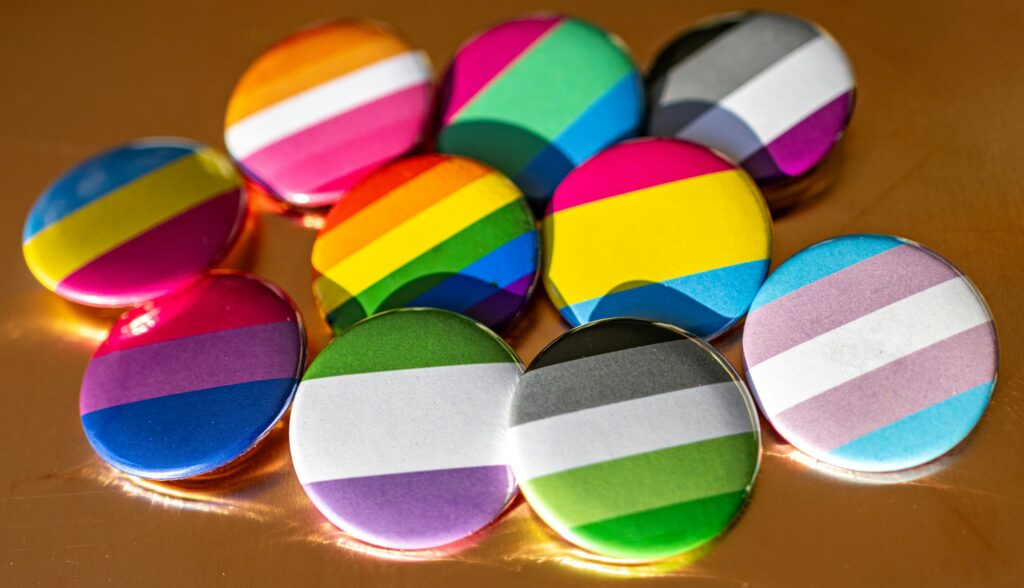
Image “a bunch of colorful buttons sitting on top of a table” by Marek Studzinski is licensed under Unsplash License.
This invisibility of Sinophone queerness can be attributed to differing interpretations of androgyny, gender non-conformity, and masculinity in assigned-female bodies, shaped by distinct sets of cultural tools. This mismatch often leads to self-censorship and stress for QIS, discouraging them from seeking belonging in host-country queer communities. Theoretically, it also challenges the Western model of queer liberation. The Western model of queer resistance emphasises disrupting and deconstructing normative categories, often through bodily resistance to gendered performativity (Butler, 1990; Chen, 2006). However, the cultural resistance repertoire in the host-country queer community may lack the capacity to receive and engage with different tools of queer expression and challenge, particularly when they originate from distinct queer cultures. This is also linked to the previously discussed lack of diverse presentations of queerness, leading locals to interpret these expressions through assumptions rather than an understanding of their contexts.
Alternative Network of Care: Experience prior to Identities
While the previous section highlighted the difficulties for QIS in participating in mainstream UK queer spaces, their experiences also reveal new possibilities for building solidarity across marginalised groups. Beyond viewing queer communities solely as safe spaces or chosen families, they prefer to form strong relationships with people in similar positions—often other queer migrants, regardless of ethnicity, or individuals who have experienced other forms of marginalisation. For the interviewees, mutual understanding does not rest on queer identity, sexual attraction, or gender expression alone, but on the shared sense of not fitting in and the dual challenge of adapting to life in the UK while translating or concealing their queer identity when returning home. They imagine supportive social networks as consisting of people who understand these struggles.
Many interviewees found belonging and friendship with other queer immigrants, including East Asians, Latin Americans, and Eastern Europeans, recognising in them similar struggles with homophobia in their home countries. They perceived the UK as having moved past this stage, noting that their UK peers did not face such intense family pressure, and also described a limited sense of belonging within UK-based queer communities. Several participants shared that they felt more at ease in Black, Indigenous, and people of color (BIPOC) spaces. For example, Ming attended a BIPOC queer community on campus, and Veronica tried to join the organisation Queer and Asian during her student exchange. However, they still encountered barriers with second-generation immigrants, who might be racial minorities but were more attuned to British socialisation codes. Therefore, some interviewees reported stronger connections with other immigrants from countries with lower levels of queer acceptance. For example, Tess mentioned that her friendship with a Singaporean queer person helped her feel understood, “because in our countries it’s similarly depressing.” These networks of mutual understanding were usually small and intimate, often built around shared meals or informal gatherings.
Sometimes, for students with multiple minority positions, groups open to all kinds of minorities provide a sense of solidarity and non-judgement. Daisy, a Chinese student, described her positive experience in a student group called Minority in Academia in her university department. The group welcomed students from minority backgrounds, including those defined by race, nationality, sexuality, disability, or neurodiversity. Daisy shared that in mainstream spaces she often felt disliked, though she was unsure whether this was because she was Chinese, bisexual, or neurodivergent. In the student group, she felt a sense of belonging as part of a process of building solidarity with other marginalised people, and she formed deep friendships as well as a romantic relationship. However, she also reflected: “Even as a minority, if we don’t understand the oppression of other minority groups, we may not be able to support each other. For example, gender/sexual minorities, ethnic minorities, neurodiversity—these are not automatically understood.” For this reason, Daisy called for more mutual empathy and expressed high hopes for coalitions like these to become more mainstream.
Similarly, Ming also expressed their vision of a more inclusive queer community—one grounded in the exchange of marginalised experiences and a low barrier to participation. They noted, “I really like Queer Sober Spaces—they don’t rely on nightlife or alcohol, and they don’t require extensive cultural knowledge or British humour.” Ming imagined community care as more than traditional caregiving; for them, it also includes making conversational space for others: “Sometimes [British white queers] dominate conversations at gatherings without leaving room for others, particularly those who are more shy, newly arrived, or members of racial minorities, women, or transgender people. So I hope they can realise that ‘giving up the floor to others at appropriate moments’ is a form of care.” They emphasised the importance of feeling safe in such contexts—being listened to without having to fight for inclusion.
These examples show that belonging, and even solidarity, does not have to be built within strict identity categories. Rather, it can be grounded in the emotional resonance of shared marginalised experiences and the absence of what Graeber (2012) terms “interpretive labour” for one’s multiple identities. It also offers an image of “minor-to-minor exchanges” (Liu & Li, 2025), which is a form of solidarity not bound by dominant Western models. The identification with other immigrants, such as Latin Americans and Eastern Europeans, further pushes this exchange beyond regionalism, centring on the shared experience of double marginalisation. This model invites scholars and organisers to imagine solidarity based on lived experiences rather than solely on cultural identity (Croatoan, 2012), and to resist what Bhatt (2025) calls “elite capture” in identity politics, which can place excessive emphasis on symbolic representation at the expense of substantial support. Although these “outsider” friendships are quieter than formal organisations, they are equally valid. This also echoes the idea of care as a bridge across intersectional positions in building solidarity (Asante, 2021; Bhardwaj, 2024).
Conclusion
This research responds to the question of whether intersectionality fragments identities, and how it can be applied to social justice and healing. Participants’ isolation from UK queer communities arises not from their queer identity itself, but from cultural misrecognition—mainstream spaces often fail to understand how queerness is expressed and lived within Asian cultural frameworks. The intimate networks and organising practices of Sinophone QIS therefore demonstrate that coalition politics can be built not only on identity categories, but also on marginalised experiences and mutual understanding. This aligns with scholars such as Love (2011), who highlights “the politics of coalition of the stigmatised.” Such approaches challenge Western-centric models of queer organising that emphasise single-identity communities.
This framework also serves as a conceptual tool for analysing the fluid and structural dimensions of multiple identities: shared social ties, compatible ideologies, and effective communication (Van Dyke & Amos, 2017) are equally important conditions for informal coalitions and support networks. Moreover, compared to formal organising, participants’ marginalised positions reveal that care, and the practice of showing care, forms a foundation of safety and belonging. Therefore, this research argues that the politics of coalition is grounded first in the politics of care.
This research also offers practical implications for student service providers and queer organisers to imagine alternative forms of inclusion and solidarity. This research aligns with previous recommendations to provide accessible information on LGBTQ+-friendly support and to use visual cues to increase QIS’s feeling of safety in the everyday mundaneness of queer presence (Valosik, 2015). Furthermore, it offers a new insight into organisational methods—instead of offering support solely based on identity categories and existing queer cultures, organising opportunities that allow participants to connect through their shared multiple-marginalised positions could also foster belonging and supportive networks.
Still, this research calls for a larger sample of interviewees from Sinophone regions, especially including working-class and rural voices, to examine the interplay of economic and geographical structures. Continued examination of the structural forces shaping intersecting identities will be essential for both researchers and advocates seeking to address isolation among minorities, build solidarities, and foster substantive diversity.
AI Usage Disclosure
AI tools were used for transcription, translation, and proofreading. All analytical interpretation and writing were conducted solely by the author. Participants provided informed consent for the use of AI-assisted transcription.
References
Asante, G. (2021). Queer (un)like me: Contesting sameness, im/possibilities of queer/trans allyship in transnational contexts. QED: A Journal in GLBTQ Worldmaking, 8(2), 145–152.
Bhardwaj, M. (2024). “That’s what we think of as activism”: Solidarity through care in queer Desi diaspora. Journal of Lesbian Studies, 28(1), 100-124.
Bhatt, C. (2024). The revolutionary road to me: Identity politics and the Western left. Polity Press.
Butler, J. (1990). Gender trouble: Feminism and the subversion of identity. Routledge.
Chen, P. (2006). Táiwān tóngzhì lùnsù de wénhuà fānyì [Cultural translation of Taiwanese tongzhi discourse] [Master’s thesis, Institute of Culture Studies, Yang Ming Chiao Tung University]. 陽明交通大學文化研究所.
Collins, P. H. (1990). Black feminist thought in the matrix of domination. In Black feminist thought: Knowledge, consciousness, and the politics of empowerment (pp. 221–238). Routledge.
Collins, P. H. (2015). Intersectionality’s definitional dilemmas. Annual Review of Sociology, 41(1), 1–20.
Collins, P. H., da Silva, E. C. G., Ergun, E., Furseth, I., Bond, K. D., & Martínez-Palacios, J. (2021). Intersectionality as critical social theory: Intersectionality as critical social theory, Patricia Hill Collins, Duke University Press, 2019. Contemporary Political Theory, 20(3), 690.
Crenshaw, K. (1991). Mapping the margins: Intersectionality, identity politics, and violence against women of color. Stanford Law Review, 43(6), 1241–1299. https://doi.org/10.2307/1229039
Croatoan. (2012, April 30). Who is Oakland: Anti-oppression activism, the politics of safety, and state co-optation. Escalating Identity. https://escalatingidentity.wordpress.com/2012/04/30/who-is-oakland-anti-oppression-politics-decolonization-and-the-state/
Cui, L., & Song, L. (2024). Queer migration, heteronormativity and the ‘ethnic closet’: Chinese queer international students’ intersectional experience in New Zealand. European Journal of Education, 59(2), e12608.
Graeber, D. (2012). Dead zones of the imagination: On violence, bureaucracy, and interpretive labor: The Malinowski Memorial Lecture, 2006. HAU: journal of Ethnographic Theory, 2(2), 105-128.
Hu, X., & Flynn, C. (2024). Exploring the experiences of queer international students accessing mental health support in Victoria, Australia. Journal of International Students, 14(4), 624–641. https://doi.org/10.32674/jis.v14i4.5521
Keum, B. T., Brady, J. L., Sharma, R., Lu, Y., Kim, Y. H., & Thai, C. J. (2018). Gendered racial microaggressions scale for Asian American women: Development and initial validation. Journal of Counseling Psychology, 65(5), 571-585. https://doi.org/10.1037/cou0000305
Le, T. P., Bradshaw, B. T., Wang, M. Q., & Boekeloo, B. O. (2022). Discomfort in LGBT community and psychological well-being for LGBT Asian Americans: The moderating role of racial/ethnic identity importance. Asian American Journal of Psychology, 13(2), 149-157.
Liu, W., & Li, E. C. Y. (2025). The geopolitics of queer archives: Contested Chineseness and queer Sinophone affiliations between Hong Kong and Taiwan. Sexualities, 28(3), 1118-1138.
Love, H. (2011). The case for comparison: Stigma between disability and sexuality (J. Y.-C. Chang, Trans.). Cultural Studies (文化研究), 13(3), 282–295.
Nguyen, H., Grafsky, E., & Lambert-Shute, J. (2017). The experiences of lesbian, gay, bisexual, and queer international students: A systematic review. Journal of Underrepresented & Minority Progress, 1(1), 80–94. https://doi.org/10.32674/jump.v1i1.1138
Pyke, K. D., & Johnson, D. L. (2003). Asian American Women And Racialized Femininities: “Doing” Gender across Cultural Worlds. Gender & society, 17(1), 33-53.
Quach, A. S., Todd, M. E., Hepp, B. W., & Doneker Mancini, K. L. (2013). Conceptualizing sexual identity development: Implications for GLB Chinese international students. Journal of GLBT Family Studies, 9(3), 254–272.
Shih, S. M. (2010). Theory, Asia and the Sinophone. Postcolonial Studies, 13(4), 465-484.
Valocchi, S. (2005). Not yet queer enough: The lessons of queer theory for the sociology of gender and sexuality. Gender & Society, 19(6), 750–770.
Valosik, V. (2015). Supporting LGBT international students. International Educator, 24, 48-51.
Van Dyke, N., & Amos, B. (2017). Social movement coalitions: Formation, longevity, and success. Sociology Compass, 11(7), e12489.
Yang, T. S., & Ghaziani, A. (2025). Retheorizing Intersectional Identities with the Study of Chinese LGBTQ+ Migrants. Social Problems, 72(4), 1547-1564.
Zheng, H. (2025). Queer milestones: Intergenerational relations and youth transitions of Chinese queer female students residing overseas. The Sociological Review, 73(4), 844–862.
