
The Violence of Care: Sentimentality, Heroism, and Representation in Eye of the Storm
Article by Chang Chia Yun, Josephine
Abstract:
Violence can sometimes disguise itself as care. This article focuses on the analysis of the 2023 film, Eye of the Storm (Lin, 2023), discussing how under its caring façade, the narrative ultimately translates structural problems into the individual responsibility of medical workers, imposing even more violence on them. Through adapting a highly affective and sentimental narrative, the main characters in the film, the medical workers being locked in Heping Hospital during SARS, are portrayed in a binary manner as either “selfish” or “selfless”. The state and the neoliberal capitalist medical structure that failed them under this narrative as a result, become invisible; instead, the violence they encountered has been justified as their “duty” and “moral responsibility”. By calling some workers “selfish”, this narration becomes complicit with the system, secondarily harming the exploited workers in the process of turning them into the scapegoats of this medical crisis. Although this binary opposition may create dramatic tension and an emotional viewing experience for the audience, it only evokes the audience’s sympathy, which does not help push forward reflection or potentially positive change in the system. Instead of glorifying anyone as hero, what we need during these crises may be “radical care” as mentioned in Radical Care, Survival Strategies for Uncertain Times (Hobart & Kneese, 2020), which points out the importance of being able to see each other’s fragility as situated in very specific historical contexts so as to develop meaningful connections among individuals, and ideally lead to more just conditions through cooperation among individuals. This article suggests a symptomatic reading of the film, which does not see the problematic it embeds as an isolated case. Through discussing Eye of the Storm, we are actually given the opportunity to rethink representational justice and to rethink the role of cultural products in forming the sense of awareness and care in contemporary society.
Keywords: care, representation of care crisis, Eye of the Storm, sentimentality, decontextualization, neoliberalism
Header Image: Picture was AI generated by author.
The Violence of Care: Sentimentality, Heroism, and Representation in Eye of the Storm
Revisiting care crises in a post-pandemic time and space is highly crucial. Even though the deadly pandemic had caused immense casualties and tragedies around the world, the numerous care crises that happened due to the pandemic also have their potential to create “a moment of profound rapture” (Andreas, 2020), that is, to expose the problems that have long existed in this modern neoliberal capitalist world. Film is definitely a powerful instrument in representing care crises. Through vividly capturing these moments of “rapture” and through the guidance of the narrator, meaningful discussion through film can be initiated, which may ultimately lead to the reflection or even modification of our current care system and change the way we imagine care.
Nevertheless, sometimes, violence can disguise itself as care, inducing harm through the act of representation itself. In this article, the representational violence of film, especially film related to historical events, brought by the overexaggeration of sentimentality and decontextualization, lies at the center of the discussion. In a world so caught up by capitalist neoliberalism, not only are the social system and individuals highly influenced, so are the cultural products. The neoliberal logic that encourages individualism can be seen not only in people’s day-to-day interactions but also in the way cultural products choose to tell a story. Using the 2023 film, Eye of the Storm, as the analytic text, this paper wishes to discuss how violence is being produced through the film’s narrative structure; how it not only reflects, but can also potentially reproduce the neoliberal logic, influencing the way we think of care.
Looking into the film’s decontextualized storytelling and the setup of binary opposition within those in-film medical workers, this paper tries to point out that although this narration succeeds in creating dramatic tension, this way of representation not only keeps silent on the structural problems of the capitalist care system but also transfers the responsibility back onto the shoulders of those care workers. Juxtaposing Eye of the Storm with the idea of “radical care” mentioned in Radical Care, Survival Strategies for Uncertain Times—which points out the importance of being able to see each other’s fragility as situated in specific historical contexts to develop meaningful connections among individuals (Hobart & Kneese, 2020)—the paper argues that the narrative structure in Eye of the Storm fails both its potential of delivering care to these workers, and also its potential to lead its audiences to reflect upon this care crisis.
A Sentimental but Decontextualised Narrative Structure
Released twenty years after the SARS Outbreak, Eye of the Storm had its script adapted from the emergent lockdown of Taipei City Hospital, Heping Branch. With its dual protagonist structure, led by doctor Xia Zheng (夏正) and the registered nurse An Tai He (安泰河) (Peng, 2023), the film puts its focus on the inside of the hospital, depicting the inner struggles of medical workers when fighting this unknown disease that gradually loses control. The film shows how medical workers trapped in this medical crisis face the dilemma between the small self (小我) and the big self (大我) (Que, 2023).
One of the aspects worth discussing is that the film’s narration is isolated from the social context since it not only portrays the incident as somehow free from the outside world, but it also tells the story on an individual level, which focuses only on the inner struggle of the characters. Even though it was adapted from a real historical incident, the film does not put its focus on the social context that gave rise to the incident, but rather on the depiction of human emotions, to “investigate into humanity” (Peng, 2023). In an interview, director Lin mentions that “their goal is not to restore history, but to restore the multiple emotions at that moment, to enable audiences to get closer to those emotions through film.” (Peng, 2023). Instead of discussing this traumatic historical incident from a common critical stance (toward the state-led violence toward medical workers), the film evades making accusations against any political entity, presenting the story in an individual and sentimental manner, which “neutralizes” this care crisis, making it seemly “transcendent” into a pure discussion of the universal and essential topic of humanity.
This individual and sentimental way of storytelling is termed as empathetic watching (共感式觀影) by the production team. The film is said to be “Taiwan’s first example of empathetic cinema (共感式電影)” (Wu, 2023), which indicates that through the skillful use of film techniques, the film has created an immersive viewing environment for audiences that could make it extremely easy for them to feel with or to “empathize” with the characters and their predicament. For instance, the most signature scene in the film might be the one in which Doctor Xia Zhen brings the lunch boxes from A building to B building, where all the sick people are concentrated/confined. Crossing the dark passage that links building A (deemed as a safer place) and building B (deemed as a forbidden zone), Doctor Xia’s stressful and anxious mental state is significantly being portrayed. The hallway between the two buildings is extremely dark and long, following Doctor Xia’s perspective, audiences accompany him into the darkness. At this time, the whole screen is completely dark, what is left to be perceived is Xia’s heavy breathing and the sound of the trolley he is rolling. After he has reached 8B, the medical unit in B building that is most severely impacted, the ominous score joins in, establishing a tense and frightening tone for this sequence. Here, Xia only sees hallways with no one in them but disposable medical supplies on the ground, implying the severity of the short-staffing this unit is facing. Xia then sees a medical worker enter the hallway and collapse on the floor out of fatigue, presumably out of overwork, struggling to stand up. The worker promises Xia with a forced smile that she would be fine and immediately goes on carrying out her duty. The scene ends with Xia anxiously taking off the raincoat after returning to building A, for fear of being caught by the deadly virus that is widely spread in building B. In this scene that lasts nearly 5 minutes, audiences can easily feel with Doctor Xia and experience the horror of being locked in the hospital with the virus, not being able to get out.
The portrayal of the medical workers’ emotions is placed in a vacuum, which generates only the audience’s sympathy, but not a further understanding of the workers’ predicament. In his book, Humanitarian Reason, Dider Fassin mentions that the language of “moral sentiments” that talks about individual suffering has replaced the discussion on inequality, justice, structural violence, etc. Through depoliticizing suffering resulting from social injustice, the suffering has become an individualized misfortune that seems irrelevant to the social structure (Fassin & Gomme, 2012). This tendency certainly is not limited to the realm of politics. Using highly sensual effects to create an “empathetic” watching experience, the medical crisis Eye of the Storm portrays has only become a tragic story used to mobilize the audience’s sympathy toward certain characters, but not a crisis that is worth reflecting on. In that signature scene mentioned in the previous paragraph, the audience is encouraged to feel with Doctor Xia, but not those working in building B. Building B, which is desperately in need of help, is portrayed as a horrible, forbidden place that welcomes nobody. The ominous score playing in the background does not invite the audience to think about the care workers working in B build; instead, audiences are pushed away and might wish to leave, just like how Xia feels. Following Doctor Xia’s perspective, this “adventure”, this act of “peeking” into the epicenter, has significantly downplayed the urgency of answering the needs of the medical crisis. People may see the struggle that building B is facing; however, as Doctor Xia “escapes” or “retreats” back to building A, the problems of supplies shortage, excessive workloads of medical workers that is temporarily being shown are then being put aside with a relief whilst the crisis is actually still going on in building B and the workers there are still burning out without help. The tragic working conditions that Xia/ the audience just witnessed are only briefly presented, but not given a full context, making it hard for the audience to really understand the difficulties those medical workers are facing. The erasure of social context may not seem like a big deal, but echoing the “radical care” (Hobart & Kneese, 2020) mentioned before, it actually bars us from seeing how we are all victims of the same unjust social system even in seemly different scenarios, barring us from mutual understanding and meaningful connections.
Violence of the Binary Oppositional Characterization
The sentimental narration of the film also heavily relies on setting binary oppositional characters, while the “selfless” medical workers are heroicized, the “selfish” ones are morally condemned. The workers in Eye of the Storm are portrayed as either selfish or selfless, and the plot revolves around the conflicts between the collision of these two moral values. The selfish camp is represented by Doctor Xia Zheng, who is portrayed as a doctor with less passion, who only cares about his own business and does not really care about the well-being of his patients. Besides doctor Xia, some of the workers who are on strike in order to show their disagreement with the confinement and the poor working environment are also cast to the “selfish” camp under the film’s narration. Opposingly, the “selfless” camp is represented mainly by Nurse An Tai-he and his girlfriend Li Xin-yan (李心妍). These two are portrayed as loving their jobs and caring about their patients wholeheartedly. Throughout the film, they always try to get more opportunities to help, and are very upset by the “selfish” behavior of those on the selfish side.
With this binary and stereotypical portrayal, the film does create dramatic tension between these two camps, guiding its audiences to condemn those who are “selfish” and “irresponsible” on the one hand, and to praise those who stick to their job and show the “selfless”, “altruistic” characteristic in tragic moments like this on the other. The mobilization of love and hate of the audience is unjust since this kind of portrayal does not at all “restore the multiple emotions at that moment” as the director wishes (Peng, 2023); on the other hand, it oversimplifies the intricate mentality of humans. This narrative structure appeals to the neoliberal logic, downplaying the responsibilities of the government and social systems, and calling for the dedication and self-regulation of individuals.
Under this narration structure, the workers being labeled as “selfish” have turned into the scapegoats of this medical crisis, and are criticized for not working “hard enough”. In the climax scene of Eye of the Storm, the selfless doctor, Li Xin-yan, has an argument with a group of medical workers who are on strike in order to express their discontentment with being legally confined with the unknown virus and forced to work overtime. Angry about the strikers’ refusal to work, the selfless doctor, Li Xin-yan goes bang on the door of the room in which the strikers lock themselves, furiously scolds and shames these strikers. She says, “You make your co-workers unable to rest, don’t you feel ashamed hiding in there? You are a group of selfish people…, you are not qualified to ask for rights, not qualified to be a nurse, not qualified to be a doctor” (Lin, 2023, 1:21:46). But the truth is, what makes them all unable to rest is the medical system itself and the absence of complementary measures and support coming from the government after the emergent lockdown; however, in Li’s talk, she blames all of these on her co-workers “negligence”. In this narration, the faults and responsibilities of the social system have cunningly shifted onto the shoulders of the strikers as if they were not also the victims of structural violence, as if their fear and anxiety should not be taken into account. This highly echoes the logic of liberalism, which neutralizes/depoliticizes every problem, convincing individuals that problems never come from the defect of the social system, but from individuals. Calling these people selfish and shaming them for not being a good doctor or nurse, Li’s talk once again blurs the focus. Instead of asking why the strike is needed and inquiring what these workers are demanding, this strike is being portrayed as an immoral act, an act of selfishness that should be rejected.
On the contrary, through praising those “selfless” workers, even heroicizing them, the exploitation the workers receive has been justified as the “necessary sacrifice” that doesn’t need to be problematized. Opposite to the “selfish” workers who are on strike, Doctor Li, who carries out the “inspiring” talk, is being praised. The sentimental score playing in the background during Li’s furious shouts has turned her insulting words into an “inspiring talk”. With this auditory aid, the audience is prompted to feel Li’s frustration. The film glorifies Li’s devoted, non-complaining attitude in this emergency time, portraying her as a heroine who sticks to “her duty” of saving people. Her hard work is sanctified and granted high moral value, as if this hard work carried out by her and other workers did not need to be problematized as unfair exploitation.
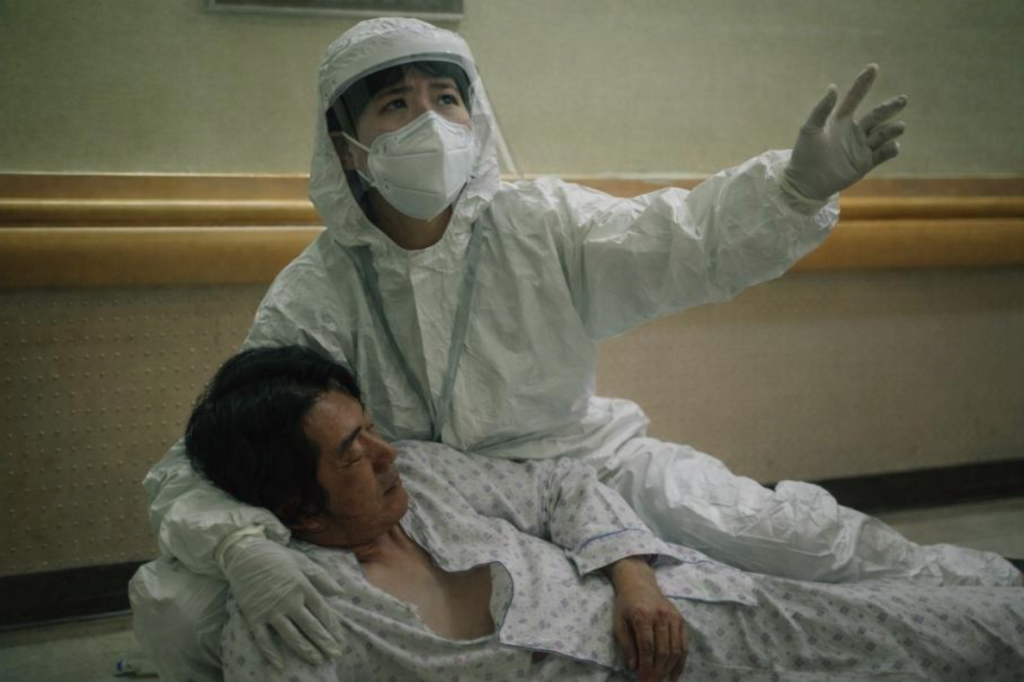
Image was AI generated by author.
The use of the language of heroism not only obscures the boundary of care labor, but also takes away the film’s potential to reflect on the care system. In Li’s emotional speech mentioned in the previous paragraph, exploitation is transferred into “the duty” that “should” be fulfilled by every medical worker, which implies that the worker should endure all injustice without complaints. Through ascribing this endless, tiresome job with high moral value by using the language of heroism, the exploitative nature of the care labor is free from being questioned or challenged, and the reciprocal support from society that should be received by the workers is also seen as not essential. Under this narration, audiences are not encouraged to discuss important questions mentioned in Cox’s article—also addressing the issue of heroizing healthcare workers during the COVID-19 pandemic—such as: What are the duties of healthcare workers during a pandemic? What are the reasonable limits to these duties? And how can we provide reciprocal support for them? (Cox, 2020). Even though these hardworking workers seemed to be represented and emphasized in the film, their predicament is viewed as their own problem, their sacrifices are deemed as necessary and can never be fully appreciated.
Conclusion
By applying a seemingly humanistic and empathetic way to represent a care crisis, Eye of the Storm eventually gets further away from delivering care to the medical workers, keeping the already unseen violence invisible, and once again, turns the structural problem into individual responsibility. The impulse to decontextualize and depoliticize this historical incident and to narrate the story in an affective and individual way echoes the neoliberal logic and feeds right back into it. However, as a cultural product, Eye of the Storm is certainly not a singular case. Keeping the idea of “radical care” (Hobart & Kneese, 2020) in mind, we as the audience should be cautious about how our feelings are mobilized, and towards whom. In addition to this, we should also pay attention to the way they think of care, and importantly, at whose expense this idea of care is being formed. Knowing that cultural products have the ability to construct public consciousness and memories, we should never stop reflecting upon them. By deconstructing the narration of the cultural products, we are calling attention to and challenging neoliberal knowledge production; through critiquing and seeing the glitch in their articulation, we are showing our concerns and care, pushing forward meaningful discussion that has the potential to benefit not only individuals but also all of us as a collective.
References
Chun Yang, Lin. (Director). (2023). Eye of the Storm [Film]. Filmagic Pictures.
Cooper, A. (2019). Neoliberal theory and film studies. New review of film and television studies, 17(3), 265-277. https://doi.org/10.1080/17400309.2019.1622877
Cox, C. L. (2020). ‘Healthcare Heroes’ problems with media focus on heroism from healthcare workers during the COVID-19 pandemic. Journal of medical ethics, 46(8), 510-513. https://www-jstor-org.ezproxy.lib.ncu.edu.tw/stable/27197880
Fassin, D., & Gomme, R. (2012). Humanitarian Reason: A Moral History of the Present (1 ed.). University of California Press. http://www.jstor.org/stable/10.1525/j.ctt1pptmk
Hobart, H. i., & Kneese, T. (2020). Radical Care. Social Text, 38, 1-16. https://doi.org/10.1215/01642472-7971067
Wu, H. (2023). 主打全台首部「共感式電影」——重現SARS封院的《疫起》做到了嗎?.換日線 Crossing. https://crossing.cw.com.tw/article/17530
Que Que. (2023, April 18, 2023 ). 專題∣林君陽導演專訪:拍《疫起》是老天爺給的暗示. Retrieved April 15 from https://www.ezding.com.tw/articlePage?content_id=3423
Xiang, Peng. (2023). 共感封院風暴:穿越銀幕上的黑,再次回到日常——專訪《疫起》監製李耀華、導演林君陽、編劇劉存菡. 放映週報, 733. Retrieved April 15, from https://funscreen.tfai.org.tw/article/38408
