Precariat Choreography: Dance as Affective Infrastructure and the Politics of Care among Indonesian Migrant Women in Taiwan
Article by Anastasia Melati Listyorini
Abstract:
This article examines the Sunday dance practices of Indonesian female migrant workers (Pekerja Migran Indonesia, or PMIs) in Taiwan, conceptualizing them as a form of “precariat choreography.” This term captures the essence of an embodied, collective resistance through which these women navigate and transform the conditions of their precarity. Grounded in six years of sustained ethnographic engagement, this study argues that dance is far from mere leisure. Instead, it functions as a vital “affective infrastructure,” a self-built, bottom-up system of emotional, social, and spiritual sustenance that counters the isolating and commodified nature of transnational care labor.
The analysis advances a threefold argument. First, these choreographic practices operate as a technology of temporal reclamation, enabling workers to reconfigure their time and bodies beyond the linear discipline of employer-imposed “contract time,” producing instead a shared and qualitative, collective “dance time.” Second, dance serves as a site for negotiating “situational piety,” through which women pragmatically reconcile Islamic ethics with bodily expression in public space. This negotiation, manifested in costume choices, spatial strategies, and internal debates, reveals a lived and context-sensitive moral framework rather than doctrinal rigidity. Finally, dance functions as a crucial medium for solidarity and mutual aid, generating a durable network of care that extends beyond the performance to provide material and emotional support during moments of crisis.
By framing these practices as a “choreography of care,” this article challenges neoliberal paradigms that individualize resilience and depoliticize migrant survival strategies. It repositions dance as a critical lens for examining justice, community formation, and decolonial practice in 21st-century Asia. Ultimately, the study demonstrates how marginalized migrant women choreograph not only movements but also subjectivities and livable futures, offering body-based epistemology from the inter-Asian margins.
Keywords: precarity, embodied resistance, affective infrastructure, migrant care workers, situational piety
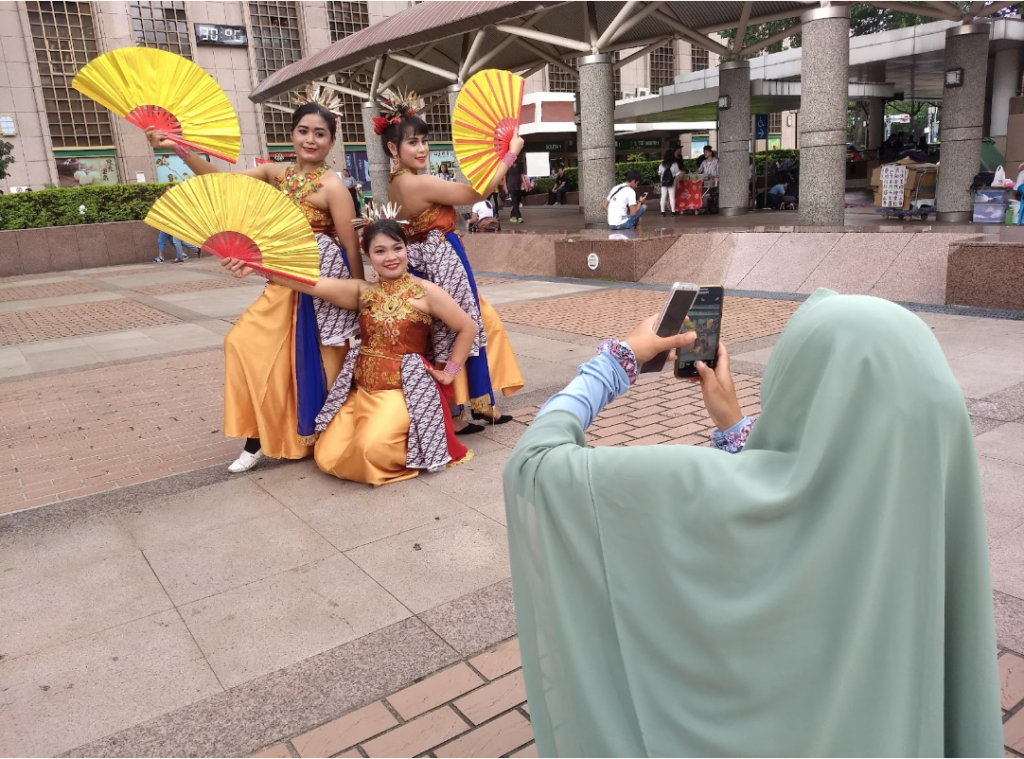
Header Image photographed by the author with the description: “Three migrant-worker dancers took a moment to pose for a photo outside Taipei Main Station before performing an Indonesian traditional dance. A hijab-wearing migrant woman, who was also one of the dancers, captured this moment of togetherness.”
- Introduction: Dancing Bodies in a Care Crisis
On Sundays, Taipei Main Station transforms. Its austere halls, typically a conduit for efficient transit, are taken over by the vibrant sounds of dangdut music, the swirl of colorful fabrics, and the synchronized movements of hundreds of Indonesian women. These migrant domestic workers, whose weeks are spent in the private, often isolating sphere of care labor, publicly assemble to dance. What appears as simple leisure is, in fact, a profound “choreography of care”.
This article argues that for Indonesian female migrant workers (Pekerja Migran Indonesia, or PMI), dance constitutes a critical affective infrastructure, a self-built system of emotional, social, and spiritual support that sustains them amid the precarity of transnational labor. It is a form of collective care that directly resists the neoliberal paradigm which frames resilience as a private responsibility. Drawing on twelve months of focused ethnographic fieldwork within a broader six-year engagement (2019-2025), including participant observation, in-depth interviews with 50 participants, and visual documentation of 37 performances, this analysis demonstrates how dance functions as a triple-edged practice of survival and becoming. We will explore how it serves as:
- A technology for reclaiming time and space from the oppressive rhythms of labor.
- A dynamic site for negotiating “situational piety,” creatively reconciling Islamic devotion with public performance.
- The foundational infrastructure for community, fostering solidarity and mutual aid that exceeds the dance itself.
By framing these practices as “precariat choreography,” we highlight how marginalized women choreograph not just dances, but their own subjectivities, crafting livable lives against the grain of global capital.
- Theoretical Framework: Becoming, Infrastructure, and the Politics of Movement
To understand the depth of these dance practices, we must move beyond binaries of victimhood and resistance. Our analysis is built on three interconnected theoretical pillars.
First, the Deleuzian concept of “becoming” (Deleuze & Guattari, 1987) allows us to see identity not as a fixed state but as a continuous, relational process. On the dance floor, PMIs engage in multiple, simultaneous becomings: they are becoming-dancer (transcending their identity as mere laborers), becoming-community (forging new kinship ties), and becoming-Muslim (negotiating their faith through bodily practice). This framework captures the fluid, emergent nature of their subjectivities.
Second, the concept of “affective infrastructure” (Berlant, 2011) helps us conceptualize dance as a vital, if intangible, public utility. Like water or electricity, the joy, solidarity, and shared memory generated through dance become essential resources for collective life. This infrastructure is built from the bottom up, compensating for the lack of formal support and providing a “container” for mutual care (Cvetkovich, 2012).
Finally, Guy Standing’s notion of the “precariat” informs our concept of “precariat choreography.” This term captures the political essence of their practice: it is an embodied response to a life defined by uncertainty, lack of agency, and commodified labor. Their choreography is a tactical reclaiming of their bodies, time, and sociality; a “counter-politics” from below.
- Choreographing Time: Reclaiming the Rhythms of Life
The life of a PMI is governed by “contract time;” a linear, monotonous schedule dictated by the needs of their employers. Their bodies become instruments for someone else’s routine, disciplined to the rhythms of cleaning, cooking, and caring. The Sunday dance gathering is, therefore, a deliberate act of temporal reclamation, a collective refusal of this alienating temporality. It is a conscious shift from being in time controlled by another to making time for themselves.
Ethnographic Data
The UTERS dance group in Taipei, for instance, uses its weekly rehearsals to create what participants call “dance time.” The group’s name itself hints at its origins: UTERS initially consisted of students from the Open University of Taiwan (Universitas Terbuka), a university known for its online distance education. This detail is significant, as it underscores how a community formed through virtual learning has forged a powerful physical presence in the city, translating the flexibility of online education into a tangible reclamation of public space and time. Their rehearsals cultivate a qualitative, collective temporality measured by the completion of a choreographic phrase, the shared exhaustion of a three-hour practice, or the collective laughter after a misstep, not by the clock. As Ibu Sari (34, domestic worker) explained, “Here, time belongs to us. It is not time to be ordered around, but time to command our own bodies to move as we please.” This embodied autonomy is a direct challenge to the constant state of responsiveness required by their work. The very slowness or rapidity of their movements becomes an expression of personal will, carving out a pocket of “temporal sovereignty” within the demanding structure of migrant life.
This reclamation is profoundly spatial. The transient, impersonal, and highly regulated space of the train station concourse is temporarily converted into a place, a meaningful site of cultural production, memory, and belonging. This transformation turns the station into what Michel Foucault termed a “heterotopia,” a real counter-site that simultaneously represents, contests, and inverts the normal spatial order of the city. Within this heterotopia, the hierarchies of the household and the public gaze are suspended. They are not pembantu (maids); they are artists, choreographers, and community leaders. The station’s floor, usually a path to be crossed, becomes a stage; its echoing architecture, once amplifying anonymity, now amplifies their music and collective presence, asserting a right to the city.
- The Danced Negotiation: Situational Piety and Embodied Faith
A central complexity in these practices is the intersection of dance with Islamic piety. Rather than a simple conflict, our research reveals a sophisticated process of negotiation we term “situational piety.” This is not a fixed set of rules, but a flexible, context-dependent strategy for embodying faith.
Ethnographic Data
This negotiation manifests in several ways:
- Costume Modifications: Dancers like Siti wear long sleeves and underskirts with her dangdut costume for public performances but not for private, women-only events. In new creative dances, less than half the dancers added headscarves where the choreography did not require them, indicating personal choice within a collective activity.
- Spatial and Audience Awareness: The same choreography is performed with more restraint under the public gaze of the main station hall than in the privacy of a dormitory rehearsal. As Dewi (28) articulated, “It’s not the dance that’s haram or halal. It’s how, where, when, and for whom you dance.” In Islamic ethical reasoning, halal (permissible) and haram (forbidden) are not necessarily inherent qualities of a practice. Rather, moral evaluation often depends on context, including intention (niat), spatial setting, audience composition, and the visibility of the body. Dewi’s statement reflects this situational understanding of religious propriety in everyday Muslim life.
- Internal Debates and Pluralism: The community is not monolithic. Lively debates occur between those advocating a “Conservative Modesty” approach and those favoring “Contextual Authenticity.” These discussions, visible on WhatsApp groups and in post-performance conversations, demonstrate a living, breathing Islamic ethics where piety is continuously interpreted and enacted.
By beginning rehearsals with prayer, the women fuse the cyclical time of faith with the creative time of dance, crafting a “pious temporality” (Mahmood, 2005) where their artistic practice becomes a potential site for ethical self-fashioning and devotion.
- Weaving the Social Fabric: Dance as Affective Infrastructure
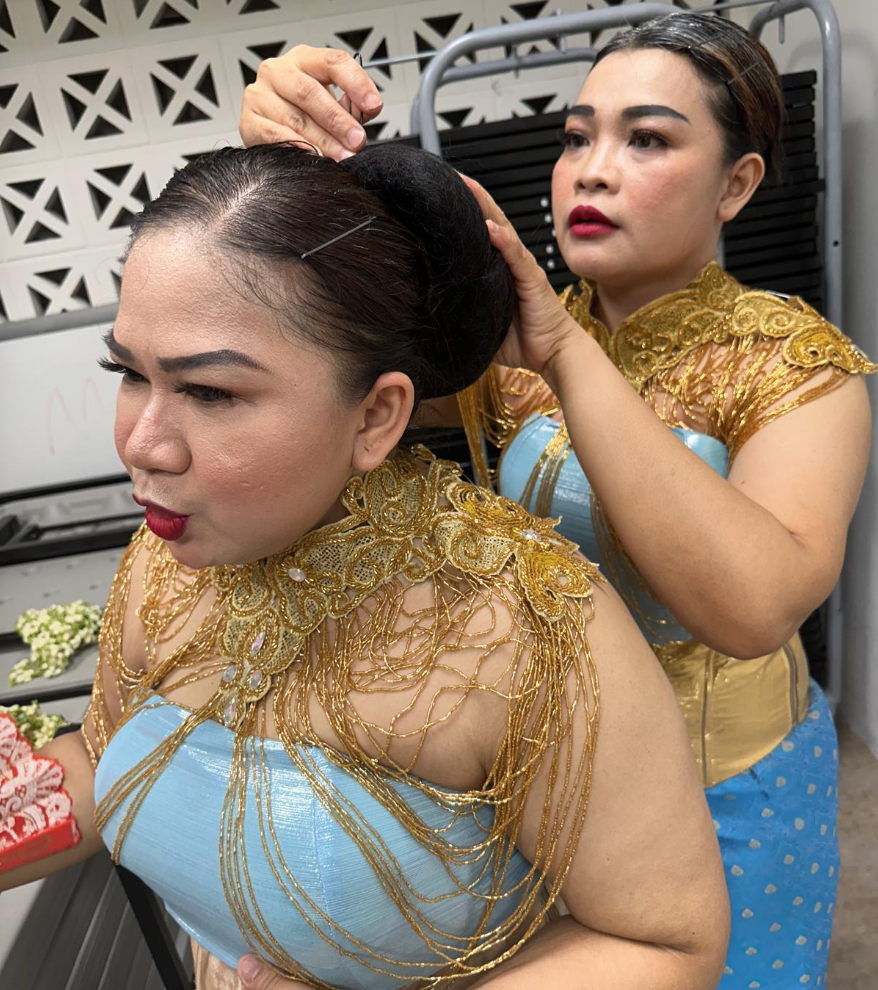
Image photographed by author with the description: “These two Indonesian migrant-worker dancers helped each other with makeup and costumes for a performance at an event organized by Rerum Novarum, held in a church hall in Taipei.”
The most critical function of this precariat choreography is its role in building and sustaining community. The dance group is the node of an affective infrastructure that provides emotional and material support far beyond the performance itself.
Ethnographic Data
– Kinship and Mutual Aid: The UTERS group exemplifies this. When one member, Sari, was denied leave to attend her father’s funeral in Indonesia, the group became her primary support system. They collected money and leveraged connections with labor NGOs on her behalf. The rehearsal space provided the socially sanctioned “cover” and the relational trust necessary for this mobilization of care.
– Digital Solidarity: The COVID-19 pandemic forced this online infrastructure to emerge. TikTok dance challenges, involving hundreds of migrants across Taiwan, became a lifeline. Performing the same choreography in isolation created a sense of co-presence. The comment sections (“Keren, Mbak! Mantap, Ce” / “Awesome, Sis!”) became an archive of collective feeling and encouragement, sustaining morale during a period of intense isolation.
– Aspirational Futurity: The digital circulation of dance videos also serves a prospective function. Sharing a polished performance with family members in Indonesia is not just reporting news; it is projecting an aspirational future self. It means claiming an identity as an agentive, creative woman, challenging the narrow image of the migrant as solely a laborer. This is a rehearsal for a future return, choreographing a new identity in the eyes of the home community.
- Conclusion: The Politics of Care from the Ground Up
The dance of Indonesian migrant women in Taiwan is far more than cultural expression: it is a sophisticated and vital politics of care, enacted through the body. Their “precariat choreography” is a powerful response to the “necropolitical logic” (Mbembe, 2003) that treats their lives as disposable. By reclaiming time, creatively negotiating their faith, and building robust affective infrastructures, they assert their humanity and agency.
The implications of this are significant. For policymakers and NGOs, it underscores that migrant well-being requires more than legal and economic solutions; it necessitates supporting the spaces, both physical and digital, where this bottom-up “infrastructure of care” can flourish. For scholars, it demonstrates that the most profound knowledge about migration, resilience, and community is often stored not in texts, but in muscle memory, collective rhythm, and the choreographed resistance of the marginalized.
The dance of Indonesian migrant women in Taiwan is far more than cultural expression: it is a sophisticated and vital politics of care, enacted through the body. Their “precariat choreography” is a powerful response to the “necropolitical logic” (Mbembe, 2003) that treats their lives as disposable. By reclaiming time, creatively negotiating their faith, and building robust affective infrastructures, they assert their humanity and agency.
The implications of this are significant. For policymakers and NGOs, supporting migrant well-being requires more than legal and economic interventions; it necessitates creating and sustaining the spaces, both physical and digital, where these embodied infrastructures of care can flourish. For scholars, these practices demonstrate that profound knowledge about migration, resilience, and community emerges not from texts or Western theories, but from inter-Asian, body-based engagements. Framed through Kuan-Hsing Chen’s Asia as Method, precariat choreography highlights how marginalized bodies produce knowledge, solidarity, and ethical practice from within Asia itself, generating insights about care, temporality, and faith that cannot be fully captured by Western-centered frameworks. Recognizing these embodied practices as legitimate epistemic sites thus challenges dominant paradigms and situates the study of migrant life, labor, and resilience firmly within inter-Asian scholarly dialogue.
AI usage disclosure
The author used artificial intelligence tools for limited purposes of language editing, rephrasing, and translation to improve clarity and readability of the manuscript. All conceptual development, theoretical framing, analysis, interpretation of data, and final editorial decisions remain entirely the author’s own responsibility.
References
Berlant, L. (2011). Cruel optimism. Duke University Press.
Chen, K. (2010). Asia as method: Toward deimperialization. Duke University Press.
Cvetkovich, A. (2012). Depression: A public feeling. Duke University Press.
Deleuze, G., & Guattari, F. (1987). A thousand plateaus: Capitalism and schizophrenia. University of Minnesota Press.
Foucault, M. (1986). Of other spaces. Diacritics, 16(1), 22–27.
Mahmood, S. (2005). Politics of piety: The Islamic revival and the feminist subject. Princeton University Press.
Mbembe, A. (2003). Necropolitics. Public Culture, 15(1), 11–40.
Standing, G. (2011). The precariat: The new dangerous class. Bloomsbury Academic.
