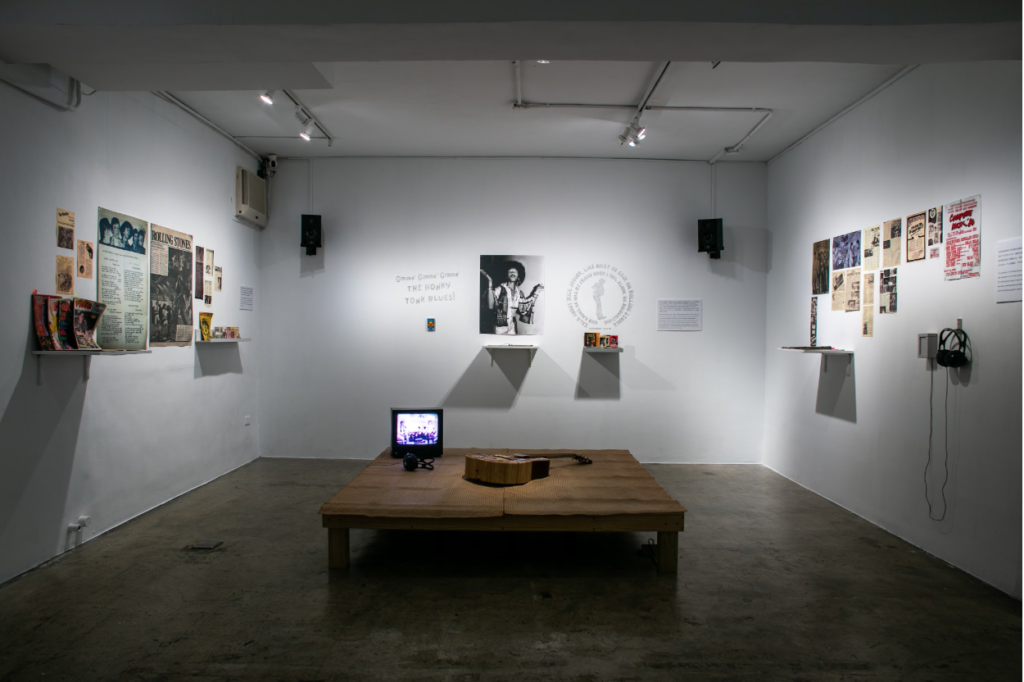
Experiencing Music in a Cube: An Alternative Output in Popular Music Research at the Rocking Indonesia Exhibition at TheCube
Article by Muhammad Irfan
Abstract:
This article [1] examines the exhibition “Rocking Indonesia: The Cultural Legacy of The Rolling Stones in Bandung” held at the alternative gallery TheCube Space in Taipei from August 30 to October 27, 2024, which I curated. The discussion situates the exhibition as a medium for presenting popular music research, specifically, the influence of the British band The Rolling Stones on the everyday lives of young people in Bandung, particularly those who came of age between the 1960s and the 1990s. The paper explores the effectiveness and limitations of exhibitions as an alternative research output in popular music studies, in comparison with conventional academic papers. Exhibitions possess a unique flexibility that allows them to reach a wider audience beyond academic circles. However, this flexibility also raises the question of how comprehensively an exhibition can convey research findings without compromising its aesthetic qualities.
Keywords: public scholarship, exhibition, popular music research, Bandung, youth culture
Header Image by Jason JS Lee/TheCube is used with permission.
Introduction: The Rolling Stones in Bandung
The Rolling Stones have had a unique connection with the youth of Bandung, especially those who grew up between the 1960s and 1990s. The band not only served as an inspiration for young people’s musical expression but also became a symbol of “coolness” for certain social groups, while being viewed as a dangerous symbol by others and was even applied to many non-musical forms, from football hooliganism to food (Irfan, 2025; 6).
This phenomenon developed gradually and was supported by many agencies, from mass media such as magazines and radio broadcasts to performances by various local artists who were seen as representations of the Rolling Stones themselves. I also believe that the city’s environment, which was originally designed as a cultural and entertainment city by the Dutch colonial administration since its establishment in the late 1800s and promoted in the 1920s with its relatively small size —only 167.3 km²— and close-knit population, allowed discourses to spread and evolve quickly (36), including in this case the rock ‘n’ roll lifestyle inspired by The Rolling Stones.
The Rolling Stones also became a kind of response to the harsh realities of urban village (kampung kota) life in Bandung (99). The band’s two iconic figures, Mick Jagger and Keith Richards, were seen as fitting representatives aligned with the media’s portrayal of them as “anti-establishment.” The existence of urban villages in Bandung was itself a result of limited housing in the city, waves of migration over several periods following political and economic instability.
One of the causes of the surge in urbanization to Bandung occurred in the 1950s, when the DI/TII (Darul Islam/Tentara Islam Indonesia) rebellion took place in the southern region of West Java such as Garut, Tasikmalaya, and Ciamis. The Movement sought to establish an Islamic state in Indonesia to replace the Republic of Indonesia led by Sukarno. These regencies, which became centers of the DI/TII movement, were seen as threatening by the public, prompting many residents of those areas to flee to Bandung, as a capital city of West Java (van Bruinessen, 2013; 47). During the Suharto era, the “Green Revolution (Revolusi Hijau)” policy in the 1960s to the 1970s, which industrialized agriculture in West Java, also created a gap between wealthy and poor farmers. Those who could no longer make a living from farming in the villages chose to move to Bandung in search of better livelihoods (12). However, this wave of urbanization exceeded the capacity of the municipal government, resulting in the emergence of informal settlements in several areas such as Taman Sari and Cicadas, which became the early forms of kampung kota in Bandung.
The Rolling Stones’ influence in Bandung also spread through hangout groups (tongkrongan), especially in urban village areas, where people would play music together via radio or pirated cassette tapes popular in Indonesia during the 1980s; play Rolling Stones songs while hanging out; or share stories about the Rolling Stones or artists inspired by them—especially Deddy Stanzah (1949–2001) from The Rollies/Superkid—by word of mouth (Irfan, 2025: 72). These practices created a distinct imagination of the Rolling Stones as something cool within these hangout circles, even if members only knew one or two songs or were familiar with just a few of their hits. This phenomenon continued for at least three decades until the 1990s, when new subcultures such as punk and metal emerged as alternative symbols of youth rebellion through music (109).
Inviting visitors to “experience” The Rolling Stones in Bandung
In the exhibition “Rocking Indonesia”, I try to replicate Bandung—and more specifically, the space where the Rolling Stones grew within society—into the exhibition space, based on the data I collected and the experiences I gained during my field research for my thesis in 2023, which was completed in June 2025, titled “Localizing the Rolling Stones: Stones Culture in Bandung, Indonesia 1960s to 1990s.” Therefore, I divided several parts of the exhibition space into several sections: the first wall presents how The Rolling Stones were portrayed in media coverage in Indonesia; the second wall shows how Deddy Stanzah replicated The Rolling Stones in his musical works; the third wall focuses on the development of bands and fans who imitated The Rolling Stones; the fourth wall presents non-musical interpretations of The Rolling Stones; and the fifth wall features illustration works by Bandung artist Mufti “Amenk” Priyanka, who draws about life in Cicadas—one of Bandung’s kampung kota that became one of my research objects, and at the same time one of the urban neighborhoods in Bandung with a strong Rolling Stones fan base.
Beyond that, on the staircase leading to the main gallery on the second floor, I also present photographs of old Bandung as a background for non-Bandung visitors to understand Bandung’s position as a cosmopolitan city since the Dutch colonial era; then I fill the exhibition space with a soundscape of daily life in Bandung’s urban kampungs, recorded and designed by Bandung sound artist Rama Saputra; I also create a bale (a wooden bench commonly found in kampung corners as a place for young people to hang out) as the center of the exhibition, emphasizing the bale as a space for sharing ideas, by adding a CRT television broadcasting a video essay titled “Once Amedeuh, Forever Amedeuh” [2] that I made to provide an overview of the Rolling Stones phenomenon in Bandung; as well as an old guitar covered with stickers of local Bandung bands that cover The Rolling Stones, to depict how this phenomenon grew from small street corners and worn-out guitars that were played in turns during jam sessions. I named this guitar “Setun Guitar.”[3]

Image by Jason JS Lee/TheCube is used with permission.
On the first wall, which tells about “How the media presented The Rolling Stones,” I display media clippings such as Aktuil and Varia—the music magazines published in Bandung and distributed in several major cities in Indonesia from the 1960s to the 1980s, and also several bootleg cassette tapes of The Rolling Stones that circulated in Bandung throughout the 1970s to the 1980s. These portrayals were often provocative, such as when Aktuil published the lyrics of the song “Street Fighting Man” in one of its editions, describing it as a song that encouraged young people to take to the streets in protest.
On the second wall is a tribute to Deddy Stanzah, a local rock star considered to have an image “closely resembling” Mick Jagger of The Rolling Stones—not only musically but also in lifestyle, especially regarding his relationship with drugs. On this wall, I present several of Deddy Stanzah’s works from his time with The Rollies, Superkid, and his solo career, in the form of CDs, cassettes, and media clippings. I also drew a silhouette of Stanzah in pencil and quoted his lyric, “You know he (Mick Jagger) was my friend when I feel alone,” to illustrate how ambitious Stanzah was toward Mick Jagger.
On the third wall, which presents fans and bands that dedicate their groups to The Rolling Stones, I display several media articles, photos, and works in MP3 format (curated by Yayasan Irama Nusantara, the Indonesian music archiving foundation) related to songs that take hooks from The Rolling Stones’ songs; the phenomenon of cover bands; and tribute events for The Rolling Stones.
On the fourth wall, I present photos of Gang Stones (Stones Alley), an alley in Bandung named after The Rolling Stones; spicy chips using The Rolling Stones logo; scarves of the Persib Bandung football supporters that also use Mick Jagger’s silhouette; as well as media archives containing literary works or poems related to The Rolling Stones; and even the use of language inspired by The Rolling Stones, such as jeger. In Bandung, jeger, which comes from the Rolling Stones’ vocalist Mick Jagger and is pronounced with a local accent, does not always refer to the singer. It is also used as a synonym for trouble maker or local tough guy (preman).
On the fifth wall, Amenk’s work in Cicadas, in my opinion, is the most accurate depiction of how jeger is understood by the people of Bandung. It refers not to the Rolling Stones’ vocalist, but to a local tough guy who might snatch your money.
All of this was created to invite visitors to experience the research journey I went through while studying this topic.
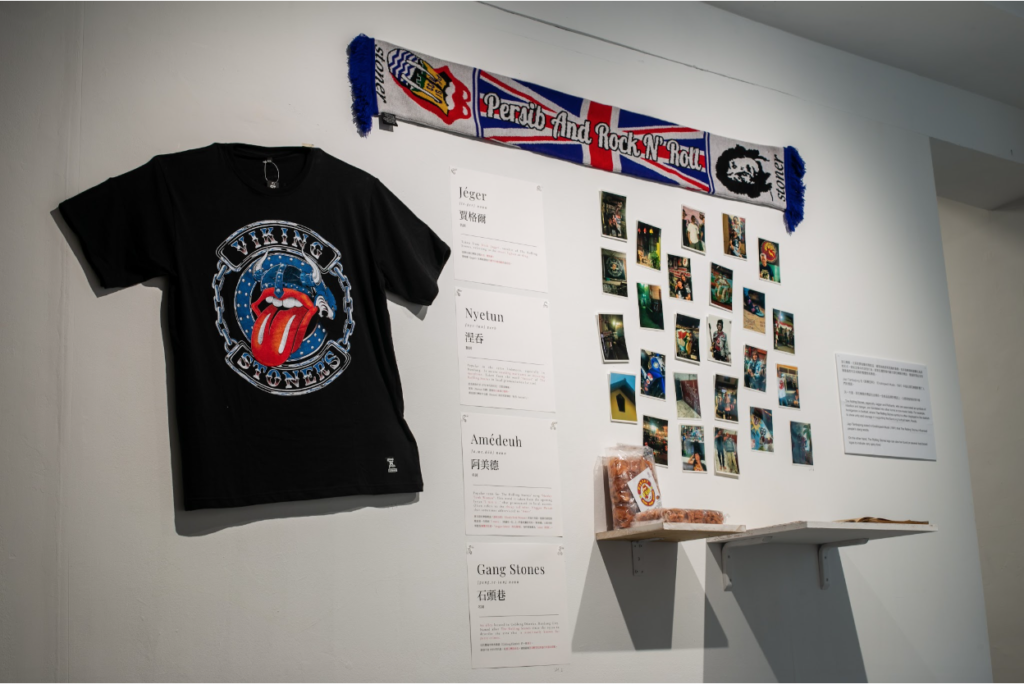
Image by Jason JS Lee/TheCube is used with permission.
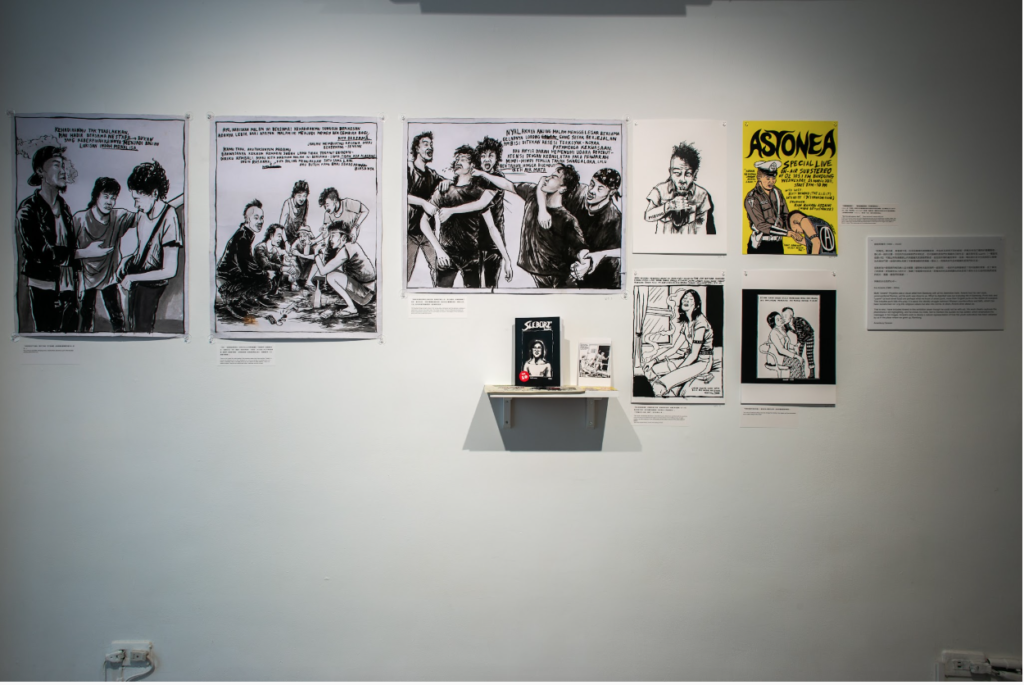
Image by Jason JS Lee/TheCube is used with permission.
To feel it, not to understand it
However, does the effort to transform this work from academic research into an exhibition necessarily make it easier to understand? Especially in my position as a foreign curator in Taiwan, conveying experiences from my hometown to an audience that is not only unfamiliar with Bandung but also with Indonesia itself. In my view, this process of translation is certainly not easy—and is, in fact, highly prone to multiple interpretations.
Quoting Kezar et al. (2018), who state that public scholarship creates more inclusive research because of its accessibility to all, exhibitions as alternative outputs for academic research may not necessarily be understood in the same way by the researcher—who, in this case, also acts as curator—and the visitors. Much like works of art that are open to wide interpretation, visitors’ experiences of the “Rocking Indonesia” exhibition may vary depending on which section they begin with. Even though efforts have been made through the exhibition catalog and the chronological structuring of materials, there is no guarantee that visitors will fully grasp the researcher’s intended meaning.
Several questions raised by visitors during the exhibition included: “Why are people in Bandung so obsessed with the Rolling Stones?”, “Why was Bandung chosen, and how is it different from other cities in Indonesia?”, “How is Bandung different from Bali?”, and “How do Indonesians, who are predominantly Muslim, respond to this musical phenomenon?”
There were also some misconceptions about how people in Bandung reinterpret The Rolling Stones into things beyond music, such as football, which were difficult for the local (Taiwanese) audience to understand due to the absence of a strong football-fan culture in Taiwan.
This became a particular challenge for the curators, who had to interpret the research and exhibition topics from the perspective of local visitors. They needed to provide simple and accessible explanations, try to explore and understand local culture, and incorporate audio experiences, not only visual, so that visitors would have multiple reference points regarding the topics presented.
Meanwhile, for visitors from Indonesia, or more specifically from Bandung, we were able to share our own experiences related to the topic, which in turn provided input and insight for the curator as a researcher. On the other hand, some visitors from England who came to the exhibition, for example, shared that certain aspects felt “strange yet familiar” to them, since The Rolling Stones are also known there as a rebellious band, followed not only for their music but also as a youth lifestyle, especially in the late 1960s.
Therefore, when presenting “Rocking Indonesia,” what I, as the curator, strive for is not so much for the audience to understand the musical experience, but rather to feel it.
At the same time, it is necessary to contextualize my hometown, which serves as the object of the exhibition, with the situation in Taiwan, where the exhibition is held. This is usually done by seeking equivalent terms, conditions, or figures within the Taiwanese context that parallel those from Bandung that I present.
For instance, when discussing the influence of Deddy Stanzah on the Bandung and Indonesian rock music scene in his era, I draw an analogy with Taiwanese rocker Wu Bai (吳俊霖), who, according to Ho (2009), is known as the “King of Taike Rock” because of “his dexterity at mixing various music conventions” and “…performing styles while embracing secularising and different Anglophone musical styles to form a hybridised, heart-throbbing, and upbeat sound” (Young T., 2005, cited in Ho). Through such explanations, the Taiwanese public can better understand Deddy Stanzah’s position within the Indonesian music scene.
Conclusion: On public scholarship
Nevertheless, I agree that through alternative outputs such as this exhibition, academic research can be made more widely accessible and reach diverse audiences including policymakers, students, media, the general public, a range of stakeholders, and especially marginalized communities (Kezar et al., 2018). This allows not only the ideas themselves to go beyond academic circles, but also provides flexibility for the works to be further developed, translated, and transformed into new creative forms, such as extended collaborations with other artists, or partnerships with non-academic institutions to present other research projects through their respective alternative outputs, be it exhibitions, documentary films, sonic art, and so on.
The fact that these works are open to multiple interpretations also creates a broader and more direct space for critique and improvement. Researchers are thus challenged to continue thinking critically in response to spontaneous questions from exhibition visitors, while debating and discussing those points. In the context of fellow visitors from Bandung, the exhibition also becomes a medium to share experiences and to fill or complement gaps in research data. I mention this because I held this exhibition in the midst of writing the academic manuscript, and I found the flow of ideas and insights from visitors during the opening to be an immensely valuable contribution to the writing process that followed.
Furthermore, I have always felt that although Indonesians have long been part of Taiwanese society through migration for work and education, there remains a significant lack of mutual understanding, including of the popular cultures that thrive within each society. Paramitaningrum (2013) stated that most Taiwanese still tend to view Indonesia as part of Bali and/or as a migrant labor exporting country. This perception and their partial understanding make Indonesia a less important country in Taiwan compared to other Southeast Asian countries. Understanding Indonesia as “only” a country of origin for migrant workers limits their understanding of broader Indonesian popular culture. Moreover, media coverage of Indonesia also focuses solely on migrant worker issues and is often associated with negative behaviors that shape public perceptions of Indonesia (Ng, 2023). Conversely, the familiarity of Taiwanese popular culture among Indonesians is still limited to the drama Meteor Garden and the boy band F4, which was popular in Indonesia in the early 2000s. Through the alternative exhibition output of my research on the phenomenon of The Rolling Stones in Bandung, I discovered a shared space between myself as a researcher and curator from Indonesia, Indonesian visitors living in Taiwan, Taiwanese visitors, and other international guests. Together, we could engage in dialogue and mutual understanding of popular culture in our respective countries.
Indirectly, the inclusivity of the exhibition as an alternative output of academic research not only opens up spaces for critique, discussion, and interpretation, but also builds mutual understanding, networks, and direct solidarity among curators, artists, and visitors on the topic of popular culture — in this case, The Rolling Stones — and its socio-political dimensions in Indonesia as well as its experiences in other countries.
In this way, the alternative output is not only inclusive and flexible, but also connects people through shared experiences of musical culture.
Notes
[1] This study was presented by the author in an Organized Panel at the International Association for the Study of Popular Music Southeast Asia (IASPM-SEA) Conference at National Taiwan University, August 8, 2025
[2] Amedeuh: The most famous title for the Rolling Stones’ “Honky Tonk Women” for people in Bandung. Derived from Mick Jagger’s (or perhaps Stanzah’s) pronunciation of the opening verse, “I met a ….” that sounds like “amedeuh”.
[3] Setun: Means Stones taken from the Rolling Stones refers to the local pronunciation in Bandung. The “Setun Guitar” I took as I was inspired from the popular song from the Manchester electronic outfit the Chemical Brothers, Star Guitar.
References
Barker, J. (2024). State of Fear: Policing A Postcolonial City. Durham and London. DukeUniversity Press.
van Bruinessen, Martin. (2013). Rakyat kecil, Islam, dan politik. Cetakan I. Yogyakarta: Penerbit Gading.
Ho, Tung-Hung. (2009). Taike rock and its discontent. In “Inter-Asia Cultural Studies, Volume 10, Number 4, 2009”. Routledge.
Ng, Yufita. (2023). Views and Perceptions of Indonesia among the Second-Generation of Taiwanese-Indonesians after the New Southbound Policy (NSP). International Journal of China Studies Views and Perceptions of Indonesia among the Second-Generation of Vol. 14, No. 2, December 2023, pp. 103–123
Irfan, Muhammad. (2025). Localizing the Rolling Stones: “Stones Culture” in Bandung, Indonesia 1960s to 1990s. Thesis. National Yang Ming Chiao Tung University.
Kezar, Adrianna J; Drivalas, Yianna; and Kitchen, Joseph A. (2018). Envisioning Public Scholarship for Our Time: Models for Higher Education Researchers. Routledge.
Paramitaningrum. (2013). Enhancing People-to-People Cooperation between ASEAN and East Asia Countries through Counterparts: The Case of Indonesian Student in Taiwan. Journal of ASEAN Studies, Vol. 1, No. 2, pp. 164–175
