Why Do Palestinians Fight Despite Their Defeats?
Article by Hazem Almassry
Abstract:
Why do Palestinians persist in their struggle when they are outnumbered, outgunned and outcast in the international system? This article questions the very question itself – the need to explain resistance in terms of military success, while the occupation is treated as natural and therefore requires no explanation. Drawing on the works of Frantz Fanon, Edward Said, Hannah Arendt and Patrick Wolfe, the article proposes that the Palestinian struggle cannot be understood through conventional frameworks of defeat and victory. Resistance becomes an existential state in settler colonialism, where the colonial project seeks the complete erasure of an indigenous people. There is no way to stop the fighting other than to accept disappearance. The article places Palestinian struggle in the context of other anti-colonial movements that prevailed against colonial regimes which seemed permanent but ultimately collapsed, such as Algeria and South Africa. It states that real defeat will not occur as long as Palestinians refuse to accept erasure.
Keywords: Palestinian resistance; settler colonialism; Nakba; anti-colonial struggle; erasure; right of return; Gaza; colonial time
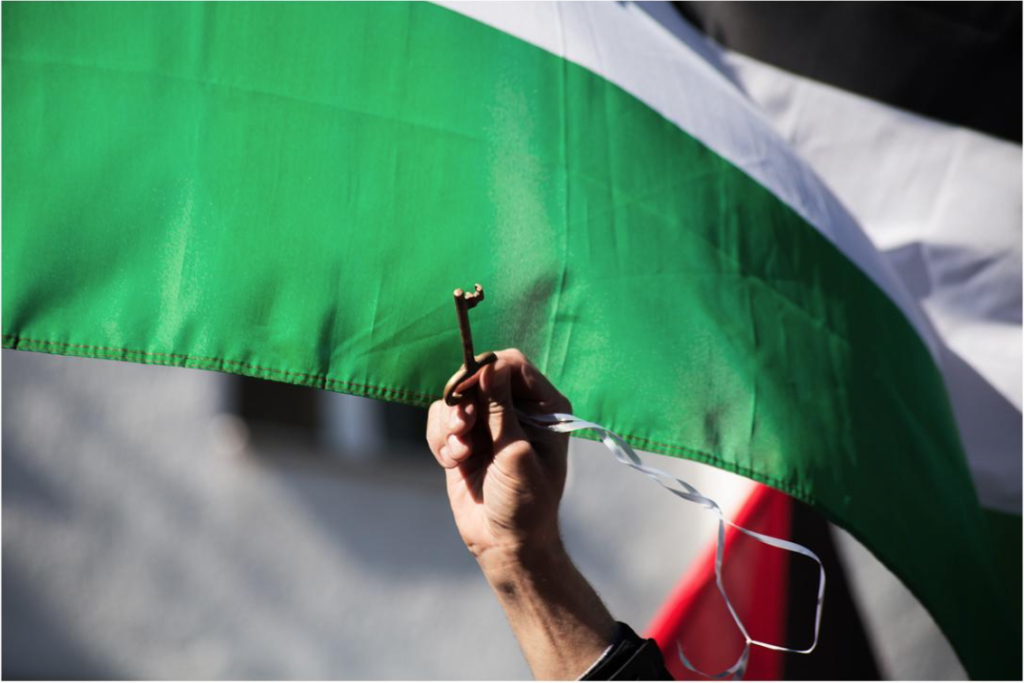
Header image: A key held against the Palestinian flag during a Nakba Day demonstration in Berlin, May 15, 2015. The key remains one of the most lasting symbols of Palestinian memory and the right of return. Photo by Montecruz Foto. Source: Wikimedia Commons, licensed under CC BY-SA 2.0.
A Loaded Question
Why do Palestinians continue to fight when they are losing, when they are outnumbered, outgunned and marginalized in the international system? This obviousness is part of the problem. It assumes that fighting is only measurable in military victory, that defeat means losing battles. This is a false and politically misleading theoretical premise because it ignores what people fight for and what they consider defeat and victory.
The question is loaded. It takes for granted that logic is the only consideration in human action in the presence of power, that military defeat should produce political surrender, that great inequalities of power must inevitably lead to accepting reality. This is pure colonial logic, even among those who are sympathetic to the Palestinian cause. Resistance must be continually rationalized, while occupation is a fact of nature that does not need to be explained.
Redefining Defeat Under Settler Colonialism
What do we mean by defeat? Yes, in terms of military engagements, Palestinians have lost almost all of the major engagements since the Nakba. They lost land. They missed out on the state that never was. They lost homes, orchards, cities.
But with regard to the struggle itself, the fundamental refusal of a project of erasure, defeat has yet to occur. This is where the basic misconception lies. Palestinians are not engaged in a battle for an immediate military triumph. They don’t fight out of ignorance about the power imbalance. Their battle is against a project of total erasure. The definition of rationality alters when there is no other choice but to fight.
It’s not a question of why they fight. We should ask instead: what would stopping mean in a context that is supposed to end their political and symbolic existence? Colonial logic assumes time is on its side. Each passing day is meant to entrench a new reality, make return harder, and reduce memory to powerless nostalgia. But there’s a very simple and disturbing fact that undermines this logic: Palestinians are still here. They have withstood the efforts to wipe them out, in the face of the Nakba, in the face of systematic expulsion, in the face of repeated massacres. This refusal is an existential act, prior to being a political position. A denial of the potential for settler colonialism’s eventual success in uprooting, in wiping out memory.
Israel is trying to halt the wheel of history. It attempts to halt time, to make its last stop the construction of a state on stolen land and the subjugation or deportation of its people. It tries convincing the world that what happened in 1948 is an irreversible starting point, everything after just administrative details. But history doesn’t stop at a moment chosen by the colonizer. People who were uprooted return. The memories they tried to erase resurface. Colonial schemes that appeared eternal have collapsed. Israel knows this all too well. That’s why it constantly pursues more displacement, tries making life impossible, works to break the will to remain.
This logic is evident in what has happened in Gaza in the recent genocide: systematic bombing of homes, total destruction of infrastructure, and conditions that make normal life impossible. The goal isn’t just defeating armed resistance. It’s pushing the population to leave, making Gaza unlivable, completing what started in the Nakba. But all this has not prevented Palestinians from remaining there. They are still resisting, still not going away.
Resistance is not a matter of pros and cons in the colonial situation, as Frantz Fanon (1961) pointed out in his study of the Algerian revolution. The colonizer wants to make his presence seem natural, the presence of the colonized seem temporary and erasable. Even when it appears irrational from a power-balance point of view, resistance reaffirms that this logic is fundamentally false.
For Palestinians it’s more than that. Zionist colonialism is not a traditional military occupation that one day may leave. It’s a complete project of erasure and replacement. It does not content itself with the control of land. It desires to wipe out the recollections of anyone who was on it. It seeks to mythologize Palestinian history, to make destroyed villages into legends, to make refugees into a passing humanitarian issue. Resistance is a challenge for this project. It requires the refugee’s key to be no random piece of metal, the destroyed village to not be forgotten. It is a deed of ownership that is in effect.
As Edward Said (1979) wrote, Palestinians resist because they know forgetting them is the ultimate goal of the Zionist project. Erasing their memory is worse than killing them. Eliminating Palestine as a name, denying and rewriting the Nakba, making return a ‘pipe dream’ impossible to achieve. Each act of resistance, no matter how small, is a simple stubborn statement in response to this project: we are still here, our memory lives, our land is not yours no matter how long you stay.
People tend to perceive Palestinian resistance as an emotional, religious and cultural reaction. This is a convenient reduction, but it obscures the deeper structure. In the Palestinian case, fighting is the means of keeping the political question open. Each time someone declares “the cause is finished,” an act of resistance appears to say the closure failed. In this sense, resistance is less about expressing power than about refusing to forget.
Classical literature defines defeat as losing the capacity to impose will. But in cases of settler colonialism, concepts get reformulated. Defeat means accepting the logic of erasure, not just losing a battle. Resistance here is an existential condition before it becomes a tactical choice. A refusal to let the people become human remnants managed through aid and guardianship rather than a political actor with the right to object.
Continuation as Resistance, History as Open
Let’s examine Palestinian history since the Nakba and we will witness a series of catastrophic defeats. 1948. 1967. The fall of the PLO in Beirut. Oslo and the impotent power it generated. Internal division. Repeated wars on Gaza. All of these are stations that can be interpreted as failures. But there’s another way of thinking about it. None of these losses put an end to the fight. They failed to make Palestinians accept disappearance. They did not succeed in closing the cause as a historical memory. It’s more a matter of continuation than a classical victory, yet it is not a final defeat either.
Continuation itself, in the context of settler colonialism, is an act of resistance. When the refugee stays in the camp and gives the key to his son, when the Palestinian in the West Bank refuses to accept isolated cantons presented under the guise of “state”, when Gazans refuse to accept the siege and repeated bombing, all this is a denial of the reality imposed. These acts of refusal may not change the power dynamic right away, but do not allow the colonial project to be completed.
Fighting causes more casualties, people say. Well, sort of, but that’s half of the story. Structural surrender also results in losses. Life becomes a string of silent losses when people can’t say no: land taken, memory erased, law rewritten against them. Fighting makes the loss visible, makes it public, instead of it being managed behind the scenes.
Resistance confronts colonial time itself. Colonialism attempts to impose its own time: the time of “facts on the ground”, of “unchangeable reality”, of gradual forgetting. Resistance breaks this time. It states that history is not over, that 1948 is an ongoing crime rather than a new beginning, that stolen land remains stolen even if a building is built on it.
In their hearts, Palestinians are certain of their victory: “Today is their day, tomorrow is OUR day!” This is not naive optimism or wishful thinking. It is a close reading of history. Every settler colonial endeavor that seemed eternal eventually collapsed. Some fell in decades, some fell in centuries, but they fell. French colonization of Algeria seemed unstoppable, then fell. Apartheid in South Africa seemed permanent, then ended. The Zionist project today appears strong, protected, backed by the world’s most powerful states. But that’s not the end of history.
Resistance is a living archive, as well. In the absence of a Palestinian state, and of official institutions to preserve collective memory, resistance is the way of preserving history. With each intifada, with each act of resistance, with each refusal, the cause is revived. It is a reminder to a new generation that may have forgotten or never known. It says to the world: this people exists, this people resists, this people refuses.
Hannah Arendt (1943) wrote about refugees losing the world that gave meaning to life, that bound a person to past, present and future. This world was lost by Palestinians. However, they did not give in to this loss. They made resistance a means of restoring meaning. Resistance was the new world, what bound them to their past, what gave meaning to their present, opened a horizon for their future.
Patrick Wolfe (2006) noted that settler colonialism isn’t just about killing the native, but about erasing their existence as a people with collective rights to land. This is what makes Palestinian resistance different: not resistance against an occupation that might end through negotiations or withdrawal, but resistance against a project that seeks to make their very existence impossible.
Palestinian resistance is part of a long history of resistance to colonialism all over the world. Even when it appeared to be hopeless, all peoples who faced settler colonialism resisted: Native Americans; Algerians against France; Zimbabweans opposed to white settlers; Vietnamese against France, then America. All were confronted with forces much stronger than they were. They were all beaten again and again. But they continued. Some ultimately won. Some still resist.
Colonial logic is linear: what has happened has happened, facts on the ground become more solid with each passing day. Resistance challenges this logic. It states that time is not linear, that crimes don’t become legitimate just because they lasted a hundred years, that stolen land remains stolen. This rejects colonialism’s core premise: that force creates right.
Palestinian resistance isn’t free of failures or contradictions. Palestinian factions committed strategic blunders. The cause was fractured by internal dissension. There were some types of resistance that did more harm than good. But none of this cancels the basic fact: the Palestinian people haven’t surrendered. This refusal to give up, in the context of a colonial project seeking their erasure, is a fundamental act of resistance.
The real question isn’t why Palestinians fight in the face of defeat. It’s how they’ve been able to persevere through these decades, through it all. Despite being vastly outnumbered militarily. Despite Israel’s unlimited Western support. Despite Arab abandonment. Despite internal divisions. Despite being besieged, starved, killed again and again. The answer isn’t superhuman organisational ability or brilliant strategy. The answer lies deeper: a refusal to be silent victims of an erasure project.
The question of why Palestinians fight despite defeats reveals more about the questioner than about those being questioned. Whoever asks it assumes cold rational logic must rule everything, that the weak must submit to the strong, that military defeat must end the struggle. But all of human history contradicts this assumption. Peoples don’t surrender just because they were defeated. Especially when the struggle is over existence itself, not interests or policies.
Palestinians fight because they know that if they don’t, they will be erased. They fight because surrender means disappearance. They fight because their memory is alive, and the land remains theirs, no matter how long the occupation lasts. They fight because if they don’t, they will have to accept the colonial narrative about them, that they are merely a hindrance to “progress,” that they should abandon their villages and cities and history.
Palestinians fight because struggle itself is the only possible refusal of erasure. As long as this cry lives, the conflict won’t end. As long as refusal stands, real defeat hasn’t happened. Because the only real defeat would be Palestinians accepting their own erasure. And that hasn’t happened yet. It won’t happen.
References
Arendt, H. (1943). We refugees. In J. Kohn & R. H. Feldman (Eds.), The Jewish writings (pp. 264–274). Schocken Books.
Fanon, F. (1961). The wretched of the earth (R. Philcox, Trans.). Grove Press.
Said, E. W. (1979). The question of Palestine. Vintage Books.
Wolfe, P. (2006). Settler colonialism and the elimination of the native. Journal of Genocide Research, 8(4), 387–409.
