Navigating Access and Ethics: Methodological Challenges in Rohingya Refugee Research in Bangladesh
Article by Monika Verma
Abstract:
This article examines the methodological and bureaucratic challenges encountered during fieldwork with Rohingya refugees in Cox’s Bazar, Bangladesh, between August and September 2025. Drawing on first-hand experiences conducting research on securitization policies affecting displaced populations, this paper addresses a critical gap in refugee studies literature: the practical realities of gaining access to highly regulated humanitarian spaces. Through reflexive analysis of visa procedures, multi-layered authorization processes, and daily security protocols, this work contributes to discussions on research ethics, positionality, and the politics of access in protracted displacement contexts. The findings highlight how bureaucratic barriers, while frustrating for researchers, reflect broader governance structures that shape both refugee experiences and knowledge production about forced displacement.
Keywords: Rohingya refugees, research methodology, fieldwork access, Bangladesh, refugee camps, research ethics, securitization
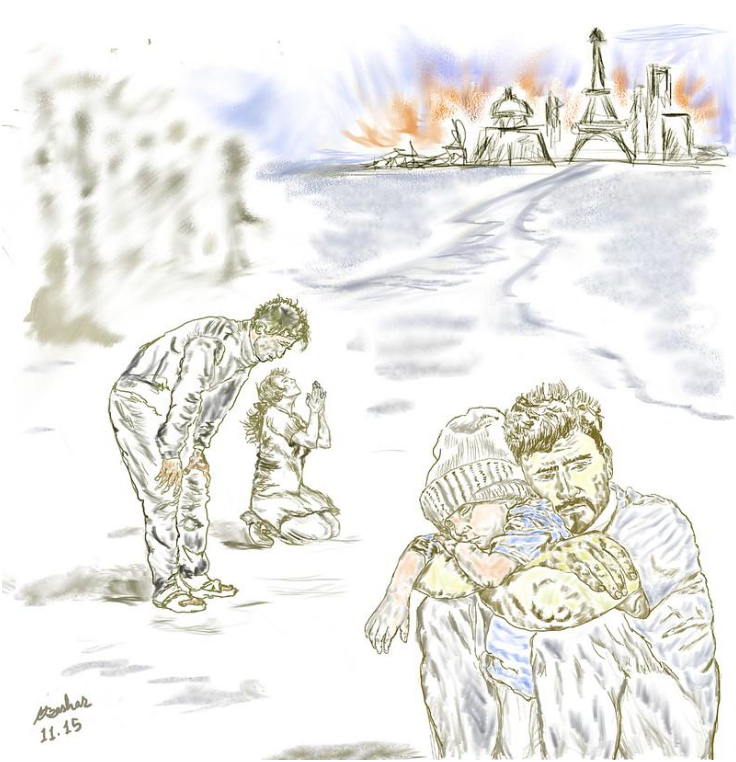
Header image “Refugees In Despair” by Ani Bashar is licensed under CC BY-NC 2.0.
Introduction
The Rohingya refugee crisis represents one of the most significant forced displacement situations in contemporary history. Following the violent crackdown by Myanmar’s military in August 2017, over 740,000 Rohingya fled to Bangladesh, joining approximately 200,000 who had arrived in earlier waves of displacement (UNHCR, 2025). Today, Cox’s Bazar hosts nearly one million Rohingya refugees across sprawling camp settlements, creating a ‘protracted refugee situation’ characterized by prolonged exile without durable solutions (Loescher & Milner, 2004). Academic engagement with the Rohingya crisis has grown substantially, spanning disciplines from political science and international relations to anthropology and public health (Farzana, 2017; Ibrahim, 2018; Milton et al., 2017). However, as Jacobsen and Landau (2003) observe, refugee studies scholarship often fails to adequately address the methodological challenges researchers face when conducting fieldwork in humanitarian contexts (Jacobsen & Landau, 2003). This gap is particularly pronounced regarding the bureaucratic dimensions of access; what Hilhorst and Jansen (2010) call the humanitarian arena’s gatekeeping mechanisms (Hilhorst & Jansen, 2010).
This article addresses this lacuna by providing a detailed, reflexive account of conducting research with Rohingya refugees in Bangladesh. As a postdoctoral researcher investigating ‘Securitization of Migration in South Asia: Implications for Rohingyas,’ I spent one month (August-September 2025) conducting fieldwork in Cox’s Bazar, Bangladesh. My research examined how securitization policies in host states affect refugee populations, necessitating direct observation and interviews within camp settings. What I initially anticipated as a straightforward research trip revealed itself as a complex navigation of bureaucratic systems, security protocols, and ethical considerations. As I reflected in my field notes: “I thought the hardest part would be conducting interviews in one of the world’s largest refugee settlements. I was wrong. The real challenge began months before I even boarded my flight—with a visa application that would test my patience and determination” (Verma, 2025). This article argues that bureaucratic opacity in humanitarian research contexts functions as a technology of governance; a form of state-mediated epistemic filtering that regulates not only researcher movement but the very production of knowledge about displaced populations. Access, I contend, is not a preliminary hurdle but a layered, negotiated process that itself constitutes research finding, revealing how sovereign power operates through administrative ambiguity.
Theoretical Framework: Access, Ethics, and Power in Refugee Research
Humanitarian spaces, including refugee camps, are not neutral territories but ‘sites of governance’ shaped by complex power relations between states, international organizations, NGOs, and displaced populations (Agier, 2011; Hyndman, 2000). Access to these spaces is carefully controlled, reflecting the ‘securitization of aid’ in contemporary humanitarian governance (Duffield, 2001). This dynamic is particularly pronounced in Bangladesh, where the government maintains strict control over camp access to manage both security concerns and international narratives about the crisis (Alam, 2018; Uddin, 2022). The refugee studies literature identifies several key methodological challenges. Jacobsen and Landau (2003) outline practical obstacles including security restrictions, language barriers, and the absence of sampling frames, while Hugman, Pittaway, and Bartolomei (2011) emphasize ethical complexities when researching vulnerable populations, particularly regarding informed consent and researcher positionality (Jacobsen & Landau, 2003; Pittaway et al., 2010). However, as Mackenzie, McDowell, and Pittaway (2007) observe, much methodological discussion in refugee studies focuses on data collection techniques while underemphasizing the preliminary stages of gaining access (Mackenzie et al., 2007). The bureaucratic processes that precede actual fieldwork; visa applications, institutional approvals, security clearances; remain underexamined despite their profound influence on research design and outcomes. Critical refugee studies scholars emphasize the importance of reflexivity; examining one’s own position within power structures that shape research (Bakewell, 2008; Fiddian-Qasmiyeh & Daley, 2019). This reflexive approach requires acknowledging how researcher identity, nationality, institutional affiliation, funding sources, shapes both access possibilities and research relationships.
Navigating Bureaucratic Gatekeeping: From Visa Applications to Camp Access
My first encounter with Bangladesh’s governance of research access began with visa applications. The Bangladesh High Commission website clearly states that ‘an individual who is participating in a research/training/internship program in any government-approved agency or organization in Bangladesh is eligible to apply for a research visa,’ with processing taking seven working days (Verma, 2025). This apparent clarity proved deceptive. Among the required documents was a single line that would consume weeks: ‘Consent letter from the concerned Ministry in Bangladesh.’ This requirement exemplifies the ‘utopia of rules,’ bureaucratic processes that appear rational but whose actual operation remains opaque and inaccessible (Graeber, 2016). No government website explained how to obtain this ministerial consent. No academic forums offered guidance. This informational vacuum is not accidental. As Mountz (2011) argues in her analysis of migration bureaucracies, opacity serves governmental purposes by maintaining discretionary power and controlling access to sovereign territory (Mountz, 2011). My breakthrough came through networking with the Refugee Migration Lab at the University of Chittagong, particularly Professor Nasir Uddin, whose research on Rohingya displacement has been instrumental in documenting refugee experiences (Uddin, 2020). Professor Uddin and Professor Muhammad Faridul Alam became not merely collaborators but essential facilitators whose institutional knowledge and local networks made research possible. This dependence on local gatekeepers raises important methodological and ethical questions. While partnerships with local scholars are methodologically sound and ethically preferable to parachute research (Sukarieh & Tannock, 2013), they also create dependencies that shape research agendas. Without their expertise, I would not have navigated the visa stage successfully, revealing a problematic reality; that access to researching displaced populations often depends on informal networks rather than transparent systems, potentially excluding researchers without such connections.
The visa requirements must be understood within Bangladesh’s broader securitization of the Rohingya presence. As Buzan, Wæver, and de Wilde (1998) theorize, securitization involves framing issues as existential threats requiring extraordinary measures (Buzan et al., 1998). Bangladesh has increasingly securitized the Rohingya crisis, implementing strict movement controls, biometric registration, and surveillance systems (Alam, 2018). Research access restrictions form part of this securitization apparatus. By requiring ministerial consent and maintaining opaque procedures, the government controls not only refugee mobility but also the production of knowledge about refugees, positioning both refugees and researchers as subjects requiring state surveillance and control. Securing a visa and arriving in Dhaka represented only the first hurdle. Before entering any refugee camp, researchers must obtain clearance from the Refugee Relief and Repatriation Commissioner’s (RRRC) office in Cox’s Bazar, the administrative nerve center for refugee operations in the region. Officials need to understand research purposes, verify credentials, and ensure researchers work with legitimate institutions. The RRRC authorization process typically requires presenting detailed research proposals, institutional affiliation letters, and demonstrating connections with recognized Bangladeshi research entities. This multi-staged authorization process reflects ‘street-level bureaucracy,’ wherein front-line officials exercise considerable discretionary power in implementing policies (Lipsky, 2010). Even with RRRC clearance, each individual camp requires separate coordination with Camp-in-Charge (CiC) offices. Every camp has a CiC where researchers must register before entering, explain planned activities, and receive final permission. These officials became invaluable contacts who understood camp dynamics and provided insights crucial to research. However, this system also grants individual officials significant power over research access, creating potential for arbitrary decision-making. As one CiC officer informally explained, “We see many researchers who don’t understand our situation. We must protect the refugees from those who just want to take their stories and leave.” This statement reveals how gatekeepers view their role as protective, filtering out extractive research while facilitating work deemed beneficial to refugee communities.
Security considerations fundamentally structured daily research activities. The golden rule for international researchers and NGO workers is simple: be out of all camps by 3 PM. This firm requirement based on security assessments and safety protocols profoundly shapes research possibilities. Interview scheduling, participant observation, and relationship-building all occur within compressed timeframes. The 3 PM deadline means missing evening activities, informal social interactions, and night-time camp dynamics; dimensions of refugee life that remain largely invisible to researchers. Malkki (1995) argues that refugee camps create a ‘categorical identity’ that obscures refugees’ individual histories and lived experiences (Malkki, 1995). Temporal restrictions on researcher access compound this homogenization by limiting which aspects of refugee life become visible and documentable. The regulated research schedule produces a particular kind of knowledge; one structured around daytime, formal interactions in designated interview spaces. Reliable transportation became essential for maximizing research time within security constraints. Public transportation in the Cox’s Bazar region is limited and unpredictable, making daily car rentals crucial for maximizing research time. This logistical requirement carries significant financial implications that can exclude researchers without adequate funding, creating methodological inequalities wherein resource-rich researchers can conduct more extensive fieldwork while others face severe limitations. My driver also became a ‘shared reality’ mediator; someone who helped interpret local customs, navigate social protocols, and understand contextual nuances, highlighting how research insights often emerge from unexpected sources (Echterhoff et al., 2009). Yet such informal mediations are not epistemically neutral: my reliance on a hired driver, local professors, and camp officials as knowledge intermediaries reflects asymmetries in who can occupy the researcher role and on whose terms. These dependencies must themselves be understood as implicating this research within broader structures of knowledge production and inequality. Crucially, the restricted access conditions that structured my entry into the camps also shaped my relationship with refugees in ways that demand reflexive scrutiny. Because all interactions occurred within state-sanctioned, time-limited, and formally observed settings, the refugees I encountered were inevitably positioned as research subjects within a surveilled space rather than as interlocutors encountered on their own terms. Their perspectives on the securitization they live under thus reached me already filtered through the same bureaucratic apparatus this article analyzes.

Image “Refugee_Rohingya” by Ani Bashar is licensed under CC BY-NC-SA 2.0.
Reflexive Analysis and Implications for Refugee Studies
The bureaucratic obstacles I encountered serve multiple, sometimes contradictory functions. On one hand, they reflect legitimate concerns about refugee protection, security, and research ethics. Camps host vulnerable populations who have experienced trauma, and unrestricted researcher access could enable exploitation, data extraction, and retraumatization (Hugman et al., 2011). The multiple layers of approval, while frustrating, serve important protective functions in managing one of the world’s largest refugee populations. However, these same mechanisms also serve the state interests in controlling narratives and limiting documentation of conditions within camps. Bangladesh faces international scrutiny regarding camp conditions, movement restrictions, and repatriation policies (Human Rights Watch, 2022). By controlling researcher access, the government can influence which stories become told and which remain hidden. This duality reflects what Agamben (1998) describes as the ‘camp’ as a space of exception; simultaneously protected and excluded, governed through extraordinary measures that suspend normal legal-political frameworks (Agamben, 1998). These access challenges raise fundamental questions about research ethics in humanitarian contexts. Standard research ethics frameworks emphasize informed consent, confidentiality, and minimizing harm to participants (Mackenzie et al., 2007). However, the structural conditions governing access; bureaucratic requirements, security restrictions, time constraints; shape research relationships before participant interaction even begins. Researchers entering camps do so only with state permission, immediately positioning us within governmental power structures. As Fassin (2012) argues in his analysis of humanitarian reason, this positioning is unavoidable but must be acknowledged and critically examined (Fassin, 2012). Furthermore, the financial and institutional resources required to navigate these bureaucratic systems mean that certain types of researchers, particularly early-career scholars, and those from under-resourced institutions, face systematic exclusion. This raises questions about whose knowledge about refugees becomes legitimated and circulated in academic discourse.
Based on this experience, several recommendations emerge for researchers planning fieldwork in similar contexts. Begin visa applications at least three months before intended travel, as the ministerial consent requirement and processing unpredictability demand extended preparation periods. Do not book flights until receiving the visa, as processing times are unpredictable and delays are common. Establish relationships with local research institutions early in the planning process, ensuring these partnerships are substantive collaborations involving shared research design, co-authorship, and mutual capacity building (Fiddian-Qasmiyeh, 2024). Account for daily transportation costs, multiple trips for authorizations, and extended stays due to bureaucratic delays in research budgets. Build substantial buffer time for administrative delays and multiple clearance visits, as rigid timelines are incompatible with the unpredictable nature of bureaucratic processes in humanitarian contexts. Beyond practical advice, these experiences suggest broader methodological lessons. Researchers should explicitly discuss how they gained access, what restrictions they faced, and how these shaped research outcomes, enabling readers to critically evaluate findings and understand their limitations (Jacobsen & Landau, 2003). Partner with local researchers not merely to gain access but to genuinely share research design, implementation, and dissemination. As Fiddian-Qasmiyeh and Daley (2019) argue, decolonizing refugee research requires centering Southern scholars’ knowledge and leadership. Examine gatekeeping mechanisms as research findings themselves, not merely obstacles to overcome, considering what authorization processes reveal about how states govern displaced populations and how security restrictions shape refugee experiences. Continuously reflect on one’s positionality, power, and complicity within structures that constrain refugee lives, as working in this environment reinforces how crucial local partnerships are for any researcher attempting fieldwork in challenging contexts.
Conclusion
This account of navigating bureaucratic systems to conduct Rohingya refugee research in Bangladesh reveals methodological challenges that extend beyond technical concerns to fundamental questions about power, knowledge production, and research ethics. The multi-layered authorization processes, security restrictions, and logistical requirements that shape fieldwork access are not peripheral to research but constitute its very conditions of possibility. These gatekeeping mechanisms reflect the broader governance structures that define contemporary refugee experiences; spaces simultaneously of protection and control, international engagement and sovereign assertion, humanitarian assistance and securitized containment. By examining our own struggles to access these spaces, researchers can gain insights into the systems of power that shape refugee lives far more profoundly than my brief fieldwork visits. The Rohingya crisis represents a protracted displacement situation requiring sustained research engagement. However, such engagement must be conducted thoughtfully, ethically, and reflexively, acknowledging the power imbalances and structural constraints that shape both refugee experiences and our ability to document them. As refugee studies continue evolving, we must pay greater attention to the methodological politics of access; not as tangential logistics but as a constitutive dimension of the research enterprise. The findings presented here contribute to methodological debates in refugee studies by demonstrating that bureaucratic opacity is best understood not as institutional friction but as state-mediated epistemic filtering: a mechanism through which sovereign power governs not only the movement of refugees but the production of knowledge about them. Treating access as a layered, negotiated process, rather than a precondition for ‘real’ fieldwork, offers refugee studies a more rigorous analytical vocabulary for examining how political conditions shape what we know, and what remains unseen.
Acknowledgements
This work was supported by the OP JAC Project “MSCA Fellowships at Palacký University III” (CZ.02.01.01/00/22_010/0008685), run at Palacký University in Olomouc, Czech Republic. I express sincere gratitude to Professor Nasir Uddin and Professor Muhammad Faridul Alam at the Refugee Migration Lab, University of Chittagong, for their invaluable support.
References
Agamben, G. (1998). Homo Sacer: Sovereign Power and Bare Life. Stanford University Press. https://doi.org/10.2307/3685567
Agier, M. (2011). Managing the Undesirables: Refugee Camps and Humanitarian Government. Polity Press.
Alam, J. (2018). The Rohingya of Myanmar: theoretical significance of the minority status. Asian Ethnicity, 19(2), 180–210. https://doi.org/10.1080/14631369.2017.1407236
Bakewell, O. (2008). Research Beyond the Categories: The Importance of Policy Irrelevant Research into Forced Migration. Journal of Refugee Studies, 21(4), 432–453. https://doi.org/10.1093/jrs/fen042
Buzan, B., Waever, O., & De Wilde, J. (1998). Security: A New Framework for Analysis. In Lynne Rienner. Lynne Rienner. https://www.amazon.co.uk/Security-Framework-Analysis-Barry-Buzan/dp/1555877842
Duffield, M. (2001). Global Governance and the New Wars: The Merging of Development and Security. Zed Books.
Echterhoff, G., Higgins, E. T., & Levine, J. M. (2009). Shared Reality: Experiencing Commonality with others’ Inner States about the World. Perspectives on Psychological Science, 4(5), 496–521. https://doi.org/10.1111/j.1745-6924.2009.01161.x
Farzana, K. F. (2017). Memories of Burmese Rohingya Refugees: Contested Identity and Belonging. Palgrave Macmillan.
Fassin, D. (2012). Humanitarian Reason: A Moral History of the Present. University of California Press.
Fiddian-Qasmiyeh, E. (2024). Recentring the South in Studies of Migration. In The Palgrave Handbook of South–South Migration and Inequality (pp. 47–73). Springer International Publishing. https://doi.org/10.1007/978-3-031-39814-8_3
Fiddian-Qasmiyeh, E., & Daley, P. (2019). Routledge Handbook of South-South Relations. Routledge. https://www.routledge.com/Routledge-Handbook-of-South-South-Relations/Fiddian-Qasmiyeh-Daley/p/book/9780367659646
Graeber, D. (2016). The Utopia of Rules: On Technology, Stupidity, and the Secret Joys of Bureaucracy. Melville House.
Hilhorst, D., & Jansen, B. J. (2010). Humanitarian Space as Arena: A Perspective on the Everyday Politics of Aid. Development and Change, 41(6), 1117–1139. https://doi.org/10.1111/j.1467-7660.2010.01673.x
Hugman, R., Pittaway, E., & Bartolomei, L. (2011). When “Do No Harm” Is Not Enough: The Ethics of Research with Refugees and Other Vulnerable Groups. The British Journal of Social Work, 41(7), 1271–1287. https://www.jstor.org/stable/43771515?seq=1
Human Rights Watch. (2022, April 4). Bangladesh: New Restrictions on Rohingya Camps. Human Rights Watch. https://www.hrw.org/news/2022/04/04/bangladesh-new-restrictions-rohingya-camps
Hyndman, J. (2000). Managing Displacement: Refugees and the Politics of Humanitarianism. University of Minnesota Press.
Ibrahim, A. (2018). The Rohingyas: Inside Myanmar’s Hidden Genocide. In Hurst Publishers. https://doi.org/10.1017/CBO9781107415324.004
Jacobsen, K., & Landau, L. B. (2003). The Dual Imperative in Refugee Research: Some Methodological and Ethical Considerations in Social Science Research on Forced Migration. Disasters, 27(3), 185–206. https://doi.org/10.1111/1467-7717.00228
Lipsky, M. (2010). Street-Level Bureaucracy: Dilemmas of the Individual in Public Service. Russell Sage Foundation.
Loescher, G., & Milner, J. (2004). Protracted Refugee Situations and State and Regional Insecurity. Conflict, Security & Development, 4(1), 3–20. https://doi.org/10.1080/1467880042000206831
Mackenzie, C., McDowell, C., & Pittaway, E. (2007). Beyond “Do No Harm”: The Challenge of Constructing Ethical Relationships in Refugee Research. Journal of Refugee Studies, 20(2), 299–319. https://doi.org/10.1093/jrs/fem008
Malkki, L. H. (1995). Refugees and Exile: From “Refugee Studies” to the National Order of Things. Annual Review of Anthropology, 24(1), 493–523. https://doi.org/10.1146/annurev.anthro.24.1.493
Milton, A. H., Rahman, M., Hussain, S., Jindal, C., Choudhury, S., Akter, S., Ferdousi, S., Mouly, T. A., Hall, J., & Efird, J. T. (2017). Trapped in Statelessness: Rohingya Refugees in Bangladesh. International Journal of Environmental Research and Public Health, 14(8), 942. https://doi.org/10.3390/IJERPH14080942
Mountz, A. (2011). The Enforcement Archipelago: Detention, Haunting, and Asylum on Islands. Political Geography, 30(3), 118–128. https://doi.org/10.1016/j.polgeo.2011.01.005
Pittaway, E., Bartolomei, L., & Hugman, R. (2010). “Stop Stealing Our Stories”: The Ethics of Research with Vulnerable Groups. Journal of Human Rights Practice, 2(2), 229–251. https://doi.org/10.1093/jhuman/huq004
Sukarieh, M., & Tannock, S. (2013). On the Problem of Over-researched Communities: The Case of the Shatila Palestinian Refugee Camp in Lebanon. Sociology, 47(3), 494–508. https://doi.org/10.1177/0038038512448567
Uddin, N. (2020). The Rohingya: An Ethnography of “Subhuman” Life. Oxford University Press.
Uddin, N. (2022). The Rohingya Crisis: Human Rights Issues, Policy Concerns and Burden Sharing (1st ed.). SAGE Publications Pvt. Ltd.
UNHCR. (2025, April). Rohingya Emergency. UNHCR. https://www.unhcr.org/emergencies/rohingya-emergency
Verma, M. (2025, October 8). Interviewing Rohingya People in Bangladesh: A Researcher’s Journey from Visa Applications to Camp Visits. Myanmar Studies Center. https://msc.upol.cz/nc/en/news/clanek/interviewing-rohingya-people-in-bangladesh-a-researchers-journey-from-visa-applications-to-camp-vi/
