Self-caring as a Collaborative Project: A multimodal writing with more–than–human connectivities
Article by Tan Xuan Pham
Abstract:
This study interrogates my fragments of memories and emotions as a Vietnamese M.Ed. student in Taiwan across time and space to explore how self-caring is represented and performed. Thinking with Deleuze and Guattari’s (1987) concepts of being, becoming, and affect, the subject of this study shifts from “I and myself” as an active agent to “we and ourselves” as emerging objects through connectivities of human and more-than-human entities. Central to these connectivities are the material–semiotic entanglements charged with emotions, thoughts, and feelings that construct identity and affective forces to satisfy the care needs of that identity. This multimodal writing project encompasses two pathways (Lester & Li, 2023) with one orientation of self-caring, examining the relationships between human and beyond-human beings and their cumulative affective powers that make caring and self-caring present to nourish mental health. Each pathway combines storytelling as a traditional way of knowing of Vietnamese people with photographs to contemplate the material and immaterial entanglements between us–humans and the environment. The study turns self-caring into a collaborative project instead of one’s own project and challenges the conventional viewpoint of self-caring as a self-concept, then employs interventions to refine the self.
Keywords: self-caring, posthumanism, multimodal writing
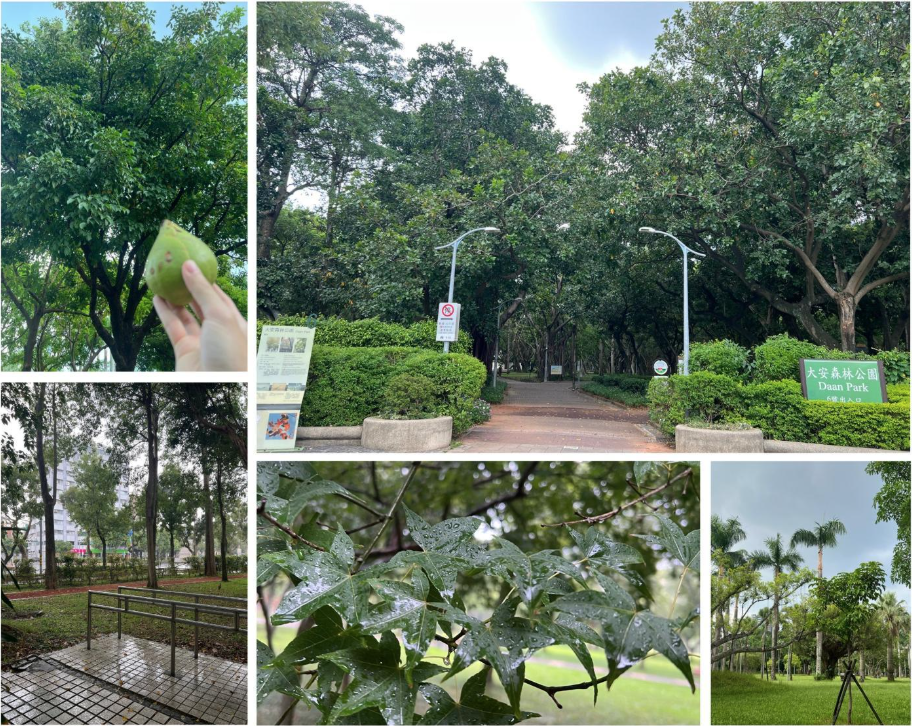
Header image “Da-an Park nourishes tan’s soul” is photographed and edited by the author.
I was writing the abstract and the draft of this study under the maple tree in Da’an Park near my university. This park is where I walked around, touched trees, listened to birds singing, took photos, read a book, and even unexpectedly experienced a little rain, to get to know the land where I will stay for 2 years. These initial connectivities established a sense of being safe, welcomed, and empowered (Narangoa & Cribb, 2005). Since then, I have become different from who I was in Vietnam. When admission and visa were approved, I imagined and worried about an international life with a variety of possible difficulties and challenges, i.e, social adaptation, culture shock, language barriers, insecurities about finance and accommodations, loss or lack of social support and networks, social isolation, alienation, and homesickness (Altinyelken et al., 2019). Exposures to weather, trees, and animals in Da’an Park, however, established the “I/self” with safety and power, transforming the previous “I/self”, filled with fear and uncertainty. The feeling of being cared for unexpectedly emerged from my exposure to and interaction with scenes and animals in the park. Then, going to the park could not become an act of self-caring conducted by me, but this was a collaborative project between the fearful and uncertain “me” and the park, co-constructing another “me” with safety and power.
Taking the emerging feeling of being cared for in Da’an Park as a point of departure, this article inquires into how the narrative of self-caring is constructed in relation to the more-than-human world, i.e., trees, animals, and weather. Theoretically framed by Deleuze & Guattari’s (1987) being, becoming, and affect and by Braidotti’s (2019) posthuman condition, self-caring in my study shifts from the cognitive capacity to care for oneself through awareness, self-control, and self-reliance (Martínez et al., 2021) to a collaborative project of caring through embracing various sources, cultures, and traditions.
The definition of self-caring or caring for oneself has undergone scrutiny in the field of healthcare, regarding human characteristics that enable self-caring acts, including awareness, self-control, and self-reliance (Martinez et al., 2021). An empirical study conducted by Altinyelken and colleagues (2019) aims to improve international students’ psychosocial well-being through a mindfulness-based program. Students were encouraged to complete instructed practices as homework and expected to gain an increase in self-awareness and emotional regulation. Their study adopts a humanist approach to care for the self, centralizing the human being as an intellectual agent with the capacity to perform and achieve care, regardless of contextual dynamics, by following scientific practices. Privatizing individual healthcare and transferring the responsibility to take care of oneself to the individual reflects the neoliberal model of self-care (Ward, 2015). Neoliberalism isolates the self from the public, conceptualizing self-care as human capital essential for success.
Thinking with being, becoming, and affect, my study places self-caring in the posthumanist condition where the “I/self” is no longer the subject of self-caring acts, but rather one of the objects together with the public in the conception of self-caring. Deleuze and Guattari (1987) conceptualize the humanist subject “I” as a mode of being in the assemblages of others, including human and beyond-human beings (longtitude) that generate affective powers charged by material-semiotic forces (latitude). The “I/self” or subjectivity is not the centralized subject or inherited from the original or ancestral one; instead, it exists relationally with other entities, “in constant negotiation with multiple others” (Braidotti, 2019, p. 54). This line of thought orients the study to approach self-caring from a care ethics perspective, understanding self-caring through the interplay of identity, relationship, and context (Ward, 2015). In different contexts, the subject “I” experiences multiple relationships with human and beyond-human objects, then formulates a situated sense of self or identity. It is this sense of self, always becoming and different, that demands the different care needs. Self-caring, therefore, does not refer to a context-independent practice conducted by a centralized subject as fixed and original, but a context-dependent practice in response to care needs arising from situated identity. It draws attention to the shifting relationships in particular contexts, in which one’s identity is (re)constructed, thereby generating different care needs. Following the aforementioned theoretical foundations, this study defines self-caring as a collaborative project of human and beyond-human beings involving a careful look at and willing listening to how everyday life changes one’s sense of self.
Combining writing as a method of inquiry (Richardson & St. Pierre, 2005) and photography as a visual approach (Le et al., 2021), this multimodal writing project interrogates how human and beyond-human beings and their affects across time and space illuminate self-caring as a collaborative project. In multimodal writing, photographs serve as a site and a framework for thinking and rethinking memories and emotions attached to particular periods of time. While writing as a praxis, photographs as a beyond-text mode of meaning encapsulate material and immaterial entanglements that make writing more influential and evocative. This article encompasses two pathways and collages, capturing assemblages of beings, becoming different, and affective forces emerging in different times and spaces, generating the feeling of being cared for and acts of caring. The outcomes of this self-caring project (1) challenge a neoliberal viewpoint of self-caring as individual practices, placing the emphasis on the I/self as an active agent who consciously knows how to self-care (Martínez et al., 2021), and (2) extend the concept of self-caring as a collaborative project to engage international students with the possibilities of the reality in which they might find the feeling of being cared for.
As a sojourner (Mori, 2000) who came to study and live temporarily in Taiwan, homesickness, cultural differences, language barriers, and even alienation have been unavoidable and gradually emerging. The following pathways present assemblages of how self-caring emerges in exposure to and interaction with NTUE and Da’an Park, and local seniors in mountain hiking. In two pathways, the subject ‘I/self’ is switched to ‘tan/himself’ with the letter ‘T’ in my name in lowercase to emphasize that there is no Tan as fixed, but a collective of different tans with emerging forces (Gibson et al., 2021).
Pathway 1: Belonging, un-belonging, and re-belonging
‘Khi ta ở chỉ là nơi đất ở, khi ta đi đất bỗng hoá tâm hồn’
(When we live, it’s just a piece of land, yet when we leave, it becomes a piece of soul)
Tiếng hát con tàu (Boat’s singing) – Chế Lan Viên
tan left Vietnam in the morning when almost all people across the country were celebrating National Day. Although tan looked forward to exploring his academic journey in another country and experiencing the education system and life in Taiwan, he really wanted to celebrate this special day. He therefore cannot hide his sadness. On the plane, the sense of belonging to his homeland was not weakened but intensified when he was flying to another country with risks and uncertainty (Thinh, 2025), leaving him with a feeling of reluctance to leave. Taking a plane to another country for years itself represents a migration, a restart of life in a new and strange living environment filled with multiple challenges (Altinyelken et al., 2020). Luckily, it was a sunny day that helped alleviate the sadness, as sunlight in Asian culture represents hope and luck. It was the sunlight added to the assemblage of National Day-plane-studying abroad that remade the meaning of leaving for a risky and uncertain place into a journey with a bright future awaiting to be explored. Upon arrival in Taiwan, as tan took a high-speed metro to Taipei, it was rainy and then became heavier when getting closer to his school. He arrived at his dormitory at 5:30 in the evening. After finishing personal hygiene, he went for a walk around the school at 11:00 under a drizzling rain and the glow of yellow streetlights. Opposite to the bright and hopeful scene engendered by plane-sunlight during the flight, this melancholic scene replaced hope and luck with loneliness and sadness. Within around 6 hours–from before boarding the flight to arriving in Taiwan–tan’s emotions, driven by desires for belonging, were reconfigured multiple times. According to Thinh, desire establishes “a cavity in which subjectivity is momentarily held and reconfigured” (2025, p. 252).
The following morning, it was sunny, and tan took a solitary stroll around the school to see what NTUE, where he would stay and learn for two years, looked like. He touched trees, picked up a maple leaf (the bottom left picture) as he often did in Vietnam when he felt stressed and disappointed (the central picture). For tan, touching trees and leaves are ways of hugging, respecting, and acknowledging Mother Nature, who protects and will protect humans and other species from any harm and risk. He watched the iconic clock tower (the bottom middle picture) and walked along the main hall. In the afternoon, tan searched for a park to visit and read a book he brought from Vietnam. He found Da’an Park within walking distance of the school. While walking along the pavement, he noticed a lot of differences. Banners, posters, and road signs were in Mandarin and sometimes English. There were some local advertisements entirely in Mandarin (the bottom right picture). People were talking in Mandarin. tan wanted to explore local food stores and shops, yet he was shy and insecure when thinking of how to communicate with others. Arriving at the park, tan walked along the paths and rows of trees (the top right picture), saw five-star maple trees in person, whispered with pigeons (the top left picture), and smiled with storks calmly eating on the green grass when he was passing by. The feeling of sadness and loneliness was replaced by calmness, safety, and empowerment. Different from the shyness caused by language barriers, calmness with silently welcoming messages from beyond-human beings in Da’an Park remade tan’s experiences of living and emotions. The affective forces emerging from the assemblage of tan-school-park with its sub-assemblages of maple leaf-bell tower-main hall and trees-birds-roads unmade and then remade tan, who was becoming different from tan in the prior assemblage of metro-rain-alone a day before.
Experiences constructed by assemblages across different times and spaces and generative affects reconfigured tan’s identities from a Vietnamese citizen with feelings of safety and confidence to a migrant with uncertainty and alienation. tan’s identity shifted as a key component of the construct changed–land. Land, beyond normally perceived as soil and sand where people walk on, becomes a space or soul, encapsulating memories and feelings, on which identity is constructed. It is land-identity as a material-semiotic entanglement that exerts a sense of un-belonging and a need for caring and being cared for when tan left his homeland. The need to be cared for, perhaps, means seeking a home or soul to feel protected and nurtured.
Pathway 2: Localizing and re-localizing
 Image “Collage 1: Soul re-making” is photographed and edited by the author.
tan and his Vietnamese colleague went on a hiking trip to Monkey Mountain in New Taipei City. This was the first time he went on a trip with local seniors, and the second time he deeply engaged with nature in Taiwan. All of the people gathered at a metro station and then took a 20-minute bus to arrive at a station near the starting point. They started greeting each other. tan was completely new to everyone else. Some seniors asked him something in Mandarin, yet tan could not respond because he did not understand. When tan introduced himself as an international student, they then switched to English, but the conversation was just about feelings in Taiwan. There was one practice that tan found similar to Vietnamese culture. They shared their food with others, i.e., sticky rice, pineapple cake, and candy. They even took a picture together before the start. The feeling of alienation in the first few days subsided when local people accepted tan’s presence as a newcomer of the hiking team and engaged him in cultural practices of sharing food and taking photos before the trip.
Image “Collage 2: Exploring ‘home’” is photographed and edited by the author.
From the bus station, it took them 20 minutes to get to the starting point of the trail. On the way walking to the trail, tan noticed some wild strawberries (the top left picture) and asked the local seniors whether they were edible. “I’m not sure, I seldom see people eating it. Yeah, but I think you shouldn’t try it…haha.”, said a local senior who gave tan a pineapple cake at the bus station. At the first stop of the trail, while the team was eating snacks, a squirrel came to ask for food (the bottom left picture). She cleverly jumped from a faraway tree branch to the shelter and slowly came closer. When tan and his colleague wanted to give her a small piece of pineapple cake, a local senior warned that they should not give food to wild animals because if they unintentionally bite us, it would be dangerous. The local senior kept asking tan and his colleague some questions about mountains and hiking habits in Vietnam, and they tried to understand each other despite their language barriers. The collective of wild strawberries-squirrel-local seniors disrupted a feeling of alienation and promoted a sense of belonging to a community, not a group of Taiwanese citizens, but a group of hiking members regardless of different spoken languages.
Following the trail (the bottom middle picture), they hiked up and down thousands of steps. tan’s colleague asked him whether he had noticed that they were always in the middle. tan suddenly looked back and saw two team members around ten steps behind. She told him that local seniors never leave them behind, regardless of how slowly they hiked. They reached the peak of Monkey Mountain and then took a rest in another shelter (the bottom right picture) where tan immersed himself in the panoramic view of the neighboring mountains from the top of Monkey Mountain (the top middle picture). After almost three hours of hiking, the team had finished its goal of exploring three peaks and tan luckily kept a record of reaching the third peak (the top right picture). Human and beyond-human beings within the collective of mountain hiking, i.e., food sharing, taking photos, smiling, warning, and local seniors always at the back, co-constructed the acts of caring that localize tan’s identity as an international student. tan’s feeling of being respected and included in the local community marked a complete practice of self-caring. Besides, while exploring natural features during hiking, tan developed his own local knowledge of Taiwan. Local knowledge exerts obligations of protecting and respecting Mother Nature, similar to what tan would do in Vietnam. This supported tan to survive and live sustainably in the beautiful island (Narangoa & Cribb, 2005).
Through two pathways, the representations of self-caring are constructed by human and beyond-human beings, fragmented across time and space, and entangled with emerging material-semiotic forces. tans, in numerous moments of self-caring, were not those who employed acts of caring for the self because tans did not pre-exist, yet were (re)made as the outcomes of experiences. In the first pathway, since on board, tan with an identity as an immigrant who was seeking his soul/home/land, constructed by the assemblages of plane-studying abroad and intensified by rain-yellow streetlight glow and advertisement poster-language, became less vulnerable by an affective source of belonging from the assemblage of tree-animals in the park. The project of self-caring in pathway 1 involved mostly more-than-human beings beyond human control and management, and without them, self-caring could not become present and complete. tan, in the second pathway, became more of a local student with knowledge and cultural practices from Taiwanese seniors and the Monkey Mountain through assemblages of food sharing-always at the back-warning and wild strawberry-squirrel-shelter. Affective sources of care from those human and more-than-human beings localized the ‘international’ of tan. Self-caring, from two pathways, reflects an ongoing and unpredictable arrangement of human and beyond-human beings and their inseparability in identity formation, care needs, and self-caring.
Conclusion
The study rejects the neoliberal viewpoint of self-caring, detaching the individual from the public, decentralizing relationships, and conceptualizing the individual as the active agent responsible for their own health and wellbeing (Ward, 2015). It centers posthumanist viewpoints of self-caring as a non-linear and ongoing collaborative project with human and more-than-human involvement. Drawing on this stance and the past experiences, my study suggests pieces of advice for international students to approach self-caring. Firstly, when studying abroad, we become vulnerable to everything in a new environment, and our identity as the outcome of this exposure constantly shifts. Unbelonging, engendered by a new culture and interaction, appears to be a common initial feeling for international students (Minutillo et al., 2020). It is not our fault to feel that, and it is not a bad thing. It is the beginning of our new and emerging relationships. Secondly, a sense of being cared for is never the only and final outcome of the self-caring project. Some negative feelings and emotions are emerging because of the unpredictable, not yet but to come, human and beyond-human arrangements. Once negative outcomes appear, it is again not our fault. It also does not mean that you fail to control your emotions or lose your confidence. It means the sense of being cared for has not been found yet, but it is coming when you engage more in relationships with human and non-human entities surrounding your daily life. Rather than isolating yourself in the corner of the room and crying or blaming yourself, start the project of self-caring with life around you, such as visiting the park, the zoo, community practices, and moving beyond when you become more confident and open.
References
Altinyelken, H. K., Hoek, L., & Jiang, L. (2019). Improving the psychosocial wellbeing of international students: the relevance of mindfulness. British Journal of Guidance and Counselling, 48(4), 524–536. https://doi.org/10.1080/03069885.2019.1600189
Braidotti, R. (2019). Posthuman knowledge. Polity.
Deleuze, G., & Guattari, F. (1987). A Thousand Plateaus: Capitalism and Schizophrenia. University of Minnesota Press.
Gibson, B. E., Fadyl, J. K., Terry, G., Waterworth, K., Mosleh, D., & Kayes, N. M. (2021). A posthuman decentring of person-centred care. Health Sociology Review, 30(3), 292–307. https://doi.org/10.1080/14461242.2021.1975555
Le, G. N. H., Tran, V., & Le, T. T. (2021). Combining photography and duoethnography for creating a trioethnography approach to reflect upon educational issues amidst the COVID-19 global pandemic. International Journal of Qualitative Methods, 20. https://doi.org/10.1177/16094069211031127
Lester, J. N., & Li, P.-J. (2023). Writing to know:: A pathway to self, others, and the social world. In D. L. Carlson, A. M. Vasquez, & A. Romero (Eds.), Writing and the Articulation of Postqualitative Research (pp. 118–132). Routledge.
Martínez, N., Connelly, C. D., Pérez, A., & Calero, P. (2021). Self-care: A concept analysis. International Journal of Nursing Sciences, 8(4), 418–425. https://doi.org/10.1016/j.ijnss.2021.08.007
Minutillo, S., Cleary, M., Hills, A. P., & Visentin, D. (2020). Mental health considerations for international students. Issues in Mental Health Nursing, 41(6), 494–499. https://doi.org/10.1080/01612840.2020.1716123
Mori, S. C. (2000). Addressing the mental health concerns of international students. Journal of Counseling & Development, 78(2), 137–144. https://doi.org/10.1002/j.1556-6676.2000.tb02571.x
Narangoa, L., & Cribb, R. (2005). Dynamics of Land and Identity in Pacific Asia: Reflections on attachment to land. The International Journal of the Humanities Annual Review, 1(1), 0. https://doi.org/10.18848/1447-9508/cgp/v01/58158
Richardson, L., & St. Pierre, E. A. (2005). Writing:: A method of inquiry. In N. K. Denzin & Y. S. Lincoln (Eds.), The SAGE Handbook of Qualitative Research (3rd ed., pp. 959–978). SAGE.
Thinh, M. P. (2025). Rethinking belonging: queer affect, trauma, and connection beyond conventional frameworks. Belonging., 1(3), 248–259. https://doi.org/10.1177/30290805251387522
Ward, L. (2015). Caring for ourselves? Self-care and neoliberalism. In M. Barnes, T. Brannelly, L. Ward, & N. Ward (Eds.), Ethics of Care: Critical Advances in International Perspective (pp. 45–56). Policy Press. https://doi.org/10.1332/policypress/9781447316510.003.0004
Ward, N. (2015). Care ethics, intersectionality and poststructuralism. In M. Barnes, T. Brannelly, L. Ward, & N. Ward (Eds.), Ethics of Care: Critical Advances in International Perspective (pp. 57–68). Policy Press. https://doi.org/10.1332/policypress/9781447316510.003.0005
