Unsettling the Family Legacy: Mothers, Daughters, and Aging in Hui-chen Huang’s Small Talk (2016) and Ming-tai Wang’s Cloudy (2017)
Article by Tran Ngoc Hieu and Vu Thi Kieu Chinh
Abstract:
This paper examines the representation of mothers and ageing in two Taiwanese films, Small Talk (Hui-chen Huang, 2016) and Cloudy (Ming-tai Wang, 2017), both of which confront the complexities of aging and the fraught dynamics of mother-daughter relationships. Rather than treating ageing merely as a bio-psychological process, these films highlight how old age is socially and culturally constructed, with the elderly often marginalized, invisibilised, or reduced to “absent presences.” Both films reconfigure this legacy by probing the ethics of care, empathy for the vulnerable, and the possibilities of intergenerational reconciliation in a society where modern and traditional values remain densely entangled.
Keywords: aging, mother-daughter, queer, ethics of care
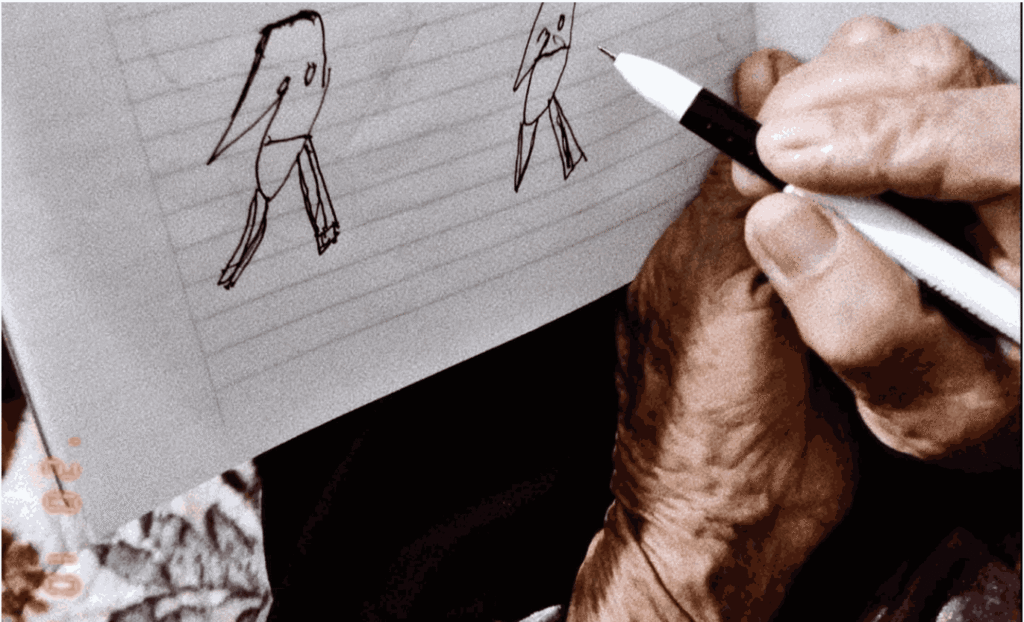
Header image “An aging hand” is photographed by author Vu Thi Kieu Chinh.
Introduction
According to projections by the National Development Council (2021, p.1), the proportion of the population aged 65 and over is expected to exceed 20% by 2025. Recent data from summer 2025 show that approximately 19.64% of the population is 65 or older (Hsiu-ling, Yu-chen & Lin, 2025), further supporting that Taiwan is indeed approaching super-aged status [1] (Janicki, Chung, & Chou, n.d.). These alarming numbers reflect a challenge faced by not only Taiwan but also many East Asian countries, where social welfare services for the elderly are often insufficient due to economic constraints (ADB, 2024). The statistics may be striking and prompt the question: In Confucian-influenced East Asian societies, where the elderly have traditionally occupied a central place within both family and community life, how might intergenerational relationships be transformed when aging is increasingly framed as an “issue”?
In this writing, we explore this question from an artistic perspective. Rather than shocking us immediately with the statistical reality of aging, cinema allows us to gradually sense the poignancy of growing old in a society where the growth of a population does not correspond to an increase in visibility or presence. Two selected Taiwanese films – Small Talk (Hui-chen Huang, 2016) and Cloudy (Ming-tai Wang, 2017) – both explore family issues that emerge between mothers and daughters. These films confront complex dimensions of aging and the mother-daughter relationship, posing important questions about intergenerational understanding and empathy. Huang’s documentary belongs to the autobiographical genre, in which the female director tries to bridge the distance between herself and her mother, a lesbian Taoist priestess. Meanwhile, Wang’s narrative film delves into relationships shaped simultaneously by burdens of responsibility, portraying a 60-year-old single woman living with her frail, mobility-impaired elderly mother who can no longer care for herself.
- Alienation of the elderly in modernity
It is necessary to recognize that aging is an intersectional concept: it is both a physiological–psychological process of human life and a cultural construction. Aging is not only identified through visible signs such as wrinkled skin, weakening eyesight, graying hair, or loose teeth, but is also tied to subjective states of being (Tran, 2020). A person may be regarded as “old” because they possess greater lucidity, experience, or authority. Conversely, one may also be perceived as “old” when they become outdated, retire from the workforce, or grow more emotionally vulnerable. The act of defining someone as “old,” or labeling them with certain qualities, or limiting them from certain social activities, cannot be a natural process but an outcome of social management. As shown in the report on population aging, assessing whether a country is young or old is always linked to forecasts or warnings about the future labor force, and from there, to discussions of economic trends. Aging is not merely an individual process; it also reflects the pace of societal change. In Small Talk and Cloudy, each character embodies different stories of aging, yet they collectively reveal the marginalized condition of individuals belonging to minority or socially peripheral groups.
Cloudy emphasizes this marginalization through its depiction of Cloudy and her mother’s living environment: a deserted housing block about to be demolished. A young print newspaper deliveryman explains that Cloudy’s subscription was canceled because “it’s no longer worth the trouble.” (Wang, 2017, 5:43). In this line, the young man encapsulates society’s indifference toward the elderly: maintaining connections with them is seen as having little value. If news is considered a metaphor for connection to the present, then canceling it is essentially a blunt rejection. This act of rejection becomes even more pronounced as modern society no longer provides the elderly with basic services. As Cloudy snaps at her mother after being repeatedly asked to fix the video player so she can watch her old Peking opera tapes: “Nobody fixes them anymore. Now people use DVDs” (Wang, 2017, 22:15). Once a famous Peking opera performer, Mrs. Han lives in nostalgia. But not only can DVDs no longer bring her back to traditional music, the performances nowadays no longer invite her either; the quality of the shows has declined, and there is no audience around. Back to the very first scene, Mrs. Han, after attending a Peking opera performance, remarks: “Time was, everyone remembered you; invited you to new shows. But these days, people don’t care about you anymore. I have to buy my own tickets” (Wang, 2017, 1:33). These things reflect how society moves on from the past and steps into the modern era, defining and discarding what is “outdated.” Items such as print newspapers, video players, tapes, and Peking opera are no longer considered relevant to the pace of contemporary life. By abandoning tangible things, society also abandons the elderly’s memories tied to these things. The old are still present, but their pasts are gradually erased, and this is how they become marginalized in a society that focuses only on the present and worships the future.
However, Peking opera is not merely something outdated that is obviously and reasonably replaced by something more practical; this art form represents a country’s cultural roots. Mrs. Han’s recollection is not merely a remembrance of her own golden days, but of a glorious chapter in her country’s history. (In Small Talk, the mother is also introduced as a Taoist priestess, which proves that elderly characters are often represented as carriers of traditional cultural values.) If the hypothesis of the reviewer Lai (2019), is correct – that Cloudy’s setting, a house near the port of Keelung in Taiwan, hints at the events of 1948, when many Chinese people fled to Taiwan due to political conflicts between the Nationalist and Communist parties – then Mrs. Han’s moaning carries an even stronger meaning: it symbolizes the marginal fate of displaced people. In this light, her memories of Peking opera resemble a longing for home, a lost memory. But even without any historical indicators, Peking opera itself is already a highly symbolic art form that “shows the great and sincere emotion and spirit of the Chinese nation” (Liu, 2021, p. 181). The act of ignoring Peking opera by people today signals not only a loss of cultural roots, as reflected in ruptured family relationships and weakened intergenerational connections, but, most importantly, it also indicates a loss of moral foundations, which is later proved by the young people’s scene.
Image “Peking Opera” by Sue Cantan is licensed under CC BY 2.0.
The film clearly highlights the binary opposition between old/young. This binary does not simply correspond to the axis of old/new, outdated/updated, or traditional/modern; it also represents an axis of principles/rebellion, spirit/materiality, morality/immorality. In the film, while Cloudy is represented as a person who always adheres to principles and rigid standards, the young group always appears amid noise: shouting, racing, drinking, etc. And this binary becomes most evident in the scene with the young group breaking into Cloudy’s house, and the newspaper boy directly assaults her as part of a grotesque bet. Cloudy’s virginity is exchanged for drugs; this incident fully demonstrates the moral decay of society. In this scene, at least two traditional East-Asian values are destroyed: the respect for the elderly is absent, and a woman’s virginity is reduced to a commodity for exchange. Being elderly is already a form of marginalization, and being an old-unmarried woman doubles this invisibility. Because of not being young enough, Cloud cannot resist the attack by a group of young men; because of being not young enough, she is also not an object of concern for the police in a rape case, as Mr. You remarks to the police: “Maybe let it go. Ms. Han is sixty and has never married. A thing like this would be humiliating for her” (Wang, 2017, 1:20:15). This line sounds empathetic at first glance, but it reveals an assumption of what suffering is considered worth noticing, worth caring about. Why should an elderly-unmarried woman feel ashamed for being raped? This reinforces an even deeper abandonment of the elderly; they lose not only material privileges but also their right to exist, to be seen, to matter. Moreover, this is not only a matter of indifference toward the elderly but also a mark of gender inequality, as elderly women become the most vulnerable and targeted for attack.
In Small Talk, there are not many elements that directly depict the social alienation of the elderly, but the wide gap between Huang’s mother and her, revolving around the mother’s sexuality, indirectly reveals it. From a young age, Huang sensed that her mother was different because she had many female friends and was always happier around them than at home with the family. The mother dated women and brought them home (after fleeing her violent ex-husband), but she never openly spoke to her daughter about her true sexuality, and this silence lasted nearly forty years. It did not mean the mother deliberately hid her sexual orientation from her daughter; it seems an avoidance, possibly arising from anxiety that her daughter would not accept her. It may also stem from the fear that admitting her queerness would also mean admitting that she had never been ready to be a mother – and had never wanted to be one. Her marriage at the age of twenty-two to an abusive, gambling husband was not her own desire but exemplified a typical arranged marriage in Asian societies, where a girl, upon reaching a certain age, must marry so she can be recorded in the family lineage and be worshipped in an ancestral grave (Huang, 2016). Modernity is supposed to welcome sexual diversity and encourage people to live according to their true identity, especially in Taiwan. [2] However, the persistent silence of Huang’s mother clearly shows that, for those who have spent more than half a lifetime in a traditional Asian society that views gender and sexuality through a binary lens, being a lesbian mother still marks them as marginal, preventing them from confidently performing their true selves. Huang’s mother lies to the women around her about her circumstances – telling her girlfriends that her daughter was adopted, that she had slept with her husband only once, and that the marriage had lasted only a week – and she never speaks about the fact that she was beaten by her husband. This reflects a profound sense of insecurity in Huang’s mother. She seeks to reject and erase a female past marked by vulnerability. In doing so, she now carries a double burden of suffering: in the past, she was a woman subjected to violence within a patriarchal society; in the present, she is a lesbian who must continually overperform strength when she is among the other women.
The complexity of Huang’s mother’s queer aging experience can be understood as a result of “compressed modernity”. This concept, proposed by Kyung-Su Chang, refers to a mode of social development in East Asian societies such as South Korea, Japan, and Taiwan, in which processes of modernization, including shifts in gender roles, occur with extreme speed and simultaneously (Yang, 2021). The key consequence of compressed modernity is that old and new values cannot coexist harmoniously; instead, they continually collide with one another, which is clearly reflected in the case of Huang’s mother: on the one hand, she appears comfortable with other women in public spaces; yet she hides herself within what is presumed to be a safer space – her family. In compressed modernity, the social sphere surprisingly becomes a site more capable of accommodating “otherness”, while the more intimate the space becomes, the more resilient patriarchal pressures remain. She cannot share her queerness openly with her siblings because it is difficult to talk to those who grew up shaped by the same prejudiced ideologies, and even harder to confess to her own daughter that she may never have wanted a nuclear family (mom-dad-child). In Small Talk, like its quiet title, the mother does not aggressively isolate herself, but her lifelong silence is the clearest sign of her endurance. In her mind, “It’s not even worth discussing” (Huang, 2016, 17:53). Compared to Cloudy, where Mr. You tells policemen to “let it go” about Cloudy being raped, Huang’s mother’s line seems to express something that has become common sense regarding the elderly: remaining silent and gradually fading into invisibility is seen as both a solution and the best way of life for the elderly.
- Caring as a burden
The point of similarity between Small Talk and Cloudy lies in their shared focus on the mother–daughter relationship, which challenges our understanding of “care.” Both films evoke a profound sense of discomfort in viewers: in Small Talk, it is the long, unbroken silence between mother and daughter – the lack of care – while in Cloudy, it is the constant arguing – the distortion of care. When discussing care, many scholars, such as Carol Gilligan, Nel Noddings, and Virginia Held, suggest that “care” is a distinctly ethical category. In In a Different Voice, Carol Gilligan (1982, p.48) suggests that women often approach ethics through relationships and caring, rather than through abstract principles such as justice, which are traditionally associated with men. If care is supposed to be the expression and central value of womanhood, why does it become something so burdensome in these films, for characters in mother–daughter relationships?
Actually, it should be clarified that the gap between burden and care is actually not that wide. Based on dictionary definitions, Noddings states that “‘care’ is a state of mental suffering or of engrossment: to care is to be in a burdened mental state, one of anxiety, fear, or solicitude about something or someone” (Onotani, 2012, p. 100). A burdened mental state can be understood as constantly being aware of someone’s presence as a possibility in one’s life, and therefore always feeling a sense of responsibility toward them. The relation between care and ethics in East Asian societies is further structured into a system of lessons on filial piety, reinforced by Confucian practices. Care cannot become an ideal quality if, when practiced as a duty, one does not feel that “receptivity, relatedness, and responsiveness” toward the cared-for, as Noddings emphasizes (Onotani, 2012, p. 101). However, this “receptive-intuitive mode” is absent in both films.
In Cloudy, the mother and daughter endure mutual suffering, which likely stems from the mismatched expectations each has of the other’s care. Always feeling like an invisible youngest child, receiving little attention and affection from her parents, Cloudy performs care for her aging mother out of duty but with underlying resentment to highlight the unfairness in the care her parents once showed to her and her siblings. From Mrs. Han’s perspective, however, Cloudy’s care always seems tasteless, like the meals she prepares, making her displeased with everything, then she scolds and accuses her daughter. The cycle of mutual resentments on both sides turns each day into a form of torment for one another, and it only worsens as they both age and also carry their own individual aging crises and miseries. Mrs. Han refuses to accept that she can no longer take care of herself and perceives herself as a burden to her daughter, which is why she cannot tolerate every formulaic act of care from Cloudy. Meanwhile, Cloudy implicitly blames her mother for the misfortunes of her love life, being a third party who could be discarded at any moment.
In Chinese (and also in Vietnamese), the term “做”母亲 (“làm” mẹ – “doing” as a mother) implies that being a mother is a form of work through fulfilling expectations, performing certain actions, and meeting conditions imposed by others. According to Byung-Chul Han (2021) in The palliative society, pregnancy, childbirth, and motherhood are situations in which women are subject to a form of psychological politics – a micropolitics – that penetrates the everyday aspects of their lives. In Small Talk, Huang’s mother is caught between being a lesbian and having a child; she struggles with how to provide care because she cannot fit the ideal image of a mother as expected. This, in turn, causes vulnerability to her daughter, and this documentary film records the daughter’s attempt to understand her mother – an effort that comes from her uncertainty about feeling her mother’s love in the way people typically imagine maternal affection.
Both films illustrate the unbearable burden of care – the destructive effect of care within the family space when one has responsibly cared for others without being able to care for oneself. At this point, we realize that the misery both bring into the mother-daughter relationship does not truly originate from the other party; rather, it is the result of prolonged suffering: elderly women are constantly pushed to the margins and deprived of care, making them only able to ‘package’ these repressed feelings and direct them toward those closest to them. Furthermore, motherhood, traditionally considered sacred, becomes the easiest outlet for releasing the social pressures and repressions they have endured. In Cruel Optimism, Berlant (2011, p.1) also raises the probing question of why people continue to attach themselves to highly formulaic fantasies of a good life – such as familial institutions – when there is abundant evidence of their instability, fragility, and exorbitant costs.
Conclusion
What has been discussed above is only a broad outline of the unsettling dynamics of family legacy, where issues of gender and aging intersect in the mother-daughter relationship. It challenges us to reconsider the meaning of care within both familial relationships and society at large. The films invite us to reflect on one of the most complex issues in narratives of aging – the ethics of care -particularly within the context of East Asian societies, where the tradition of filial piety remains deeply influential. There is still much more to explore in these two works. For instance, Small Talk stands as a rare form of queer storytelling in which the mother’s queer identity is examined through the daughter’s perspective, prompting further reflection on queer aging. In Cloudy, it is not only the aging mother-daughter pair who face struggles, but also the story of the neighboring household, where a brief narrative reveals an elderly man sexually abusing his own grandchild. Such issues compel us to confront more rigorously the societal transformations that have precipitated profound moral ruptures.
Notes
- When referring to “super-aged society”, the definition of the Organisation for Economic Co-operation and Development (OECD) is used. It specifically refers to an economy in which the share of people aged over 65 years is above 20 per cent. (Weinberger et al., 2025, p. 8)
- Gender-related activist movements in Taiwan have been highly dynamic, and in 2019, Taiwan became the first country in Asia to legalize same-sex marriage (Yang, 2021).
References
ADB. (2024). Aging well in Asia: Asian Development Bank policy report. Manila: Asian Development Bank.
Berlant, L. (2011). Cruel optimism. Duke University Press.
Han, B.-C. (2021). The palliative society [Kindle version]. Stanford University Press.
Huang, H.-C. (Director). (2016). Small Talk [Film]. Taiwan: Small Talk Productions
3H Productions.
Hsiu-ling, H., Yu-chen, L., & Lin, K. (2025, August 8). Taiwan seeks to boost elderly health care in ‘super-aged’ society. Focus Taiwan. Retrieved from https://focustaiwan.tw/society/202508080010
Janicki, J., Chung, D., & Chou, J. (n.d.). Taiwan’s aging population. Taiwan Data Stories. Retrieved November 25, 2025, from https://taiwandatastories.com/taiwan-aging-population
Lai, K.-Y. (2019, August 27). Film review: Cloudy (2017) by Wang Ming-tai. AsianMoviePulse. https://asianmoviepulse.com/2019/08/film-review-cloudy-2017-by-wang-ming-tai/
Liu, M. (2021). The implication of traditional Chinese culture in Peking opera. BCP Social Sciences & Humanities, 14, 179–182.
National Development Council. (2021). Population policy data collection (PDF). Research, Development and Evaluation Commission, Executive Yuan, Taiwan. Retrieved from https://www.ris.gov.tw/documents/data/5/2/3/PopulationPolicyDataCollection%282021%29.pdf
Onotani, K. (2012, August). Considering the central ideas of the ethics of care in N. Noddings’ Caring: A Feminine Approach to Ethics & Moral Education. Journal of Philosophy and Ethics in Health Care and Medicine, 6, 98–116.
Tran, N. H. (2020). Thế giới tuổi già trong truyện ngắn sau 1975 của Nguyễn Minh Châu [The world of old age in short stories after 1975 by Nguyễn Minh Châu]. Tạp chí Sông Hương, 374, 04–20.
Wang, M.-T. (Director). (2017). Cloudy [Film]. Taiwan: Q Place Creative Inc.
Weinberger, K., Han, A., Cocco Okada, S., Pasali, S. S., Urban, S., & Zhou, Z. (2025). Protecting our future today: Social protection in Asia and the Pacific. Asia Pacific Sustainable Development Journal, 32(1), 1–25. https://doi.org/10.18356/26178419
Yang, J.-J. (2021, June). The compressed modernity of legalizing same sex marriage in Taiwan: Digital activism, human rights discourse, and intertwined sexual, political and national identities (Master’s thesis). The City University of New York.
