Shamanism, Collective Trauma, and Moral Imagination: Ethnography and Art in Critical Dialogue
Article by Li Jia
Abstract:
This essay brings the ethnographic writings of anthropologist Kim Seong-nae into critical dialogue with the visual artworks of artist Jane Jin Kaisen, both of which engage with shamanism on Jeju Island. Based on Kim’s works, it proposes moral imagination as a framework for understanding how shamanism has been conducted as a spiritual and ethical way for Jeju people to respond to the island’s violent history of the 4.3 massacre and cope with collective trauma through cultural and religious expressions. It further highlights how the practice of mourning, materialized through shamanic rituals, ethnographic writings, and artistic expressions, commonly suggests a grassroots struggle for social justice and reconciliation in East Asia’s post-Cold War present.
Keywords: shamanism, moral imagination, Jeju Island, art, anthropology
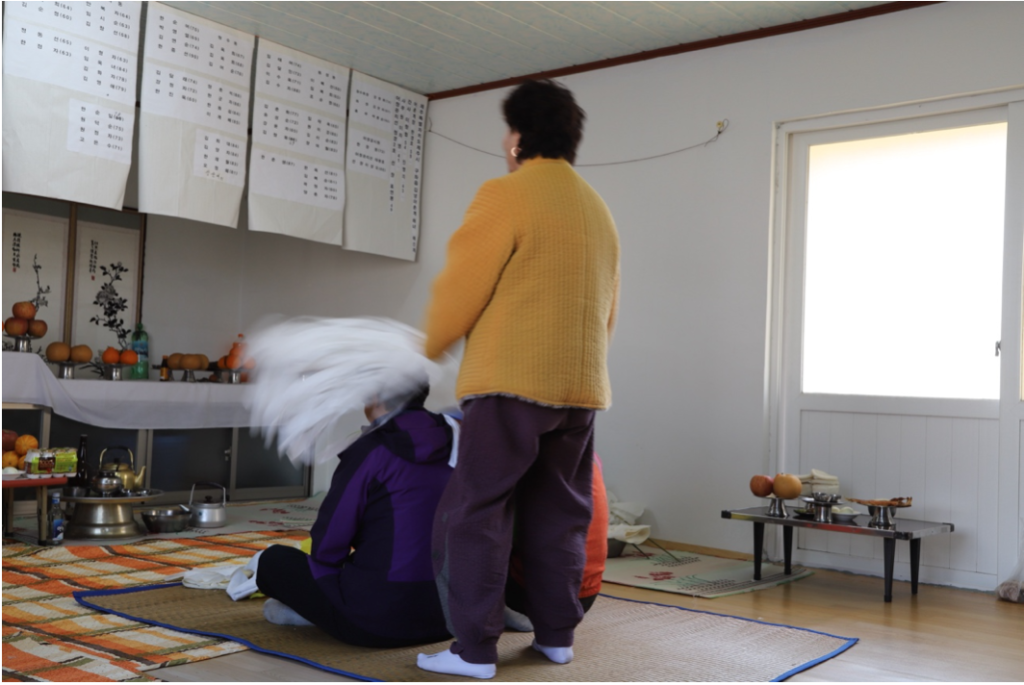
Header image “Neok-deurim ceremony” from Jeju Studies Archives is free to use.
In her early ethnography on religious life on Jeju Island (also transliterated as “Cheju”), Korean anthropologist Kim Seong-nae recounts the story of a young man in a local village who had been in poor health. One day, his aunt made her way to a local shaman, asking for a ritual that might alleviate her nephew’s illness. The shaman believed the young man’s suffering was related to his parents’ violent deaths during the 4.3 Incident and recommended a ritual for the deceased (Kim, 1989, p.253). The 4.3 Incident started from the suppression of communist guerrillas on Jeju Island, which led to brutal massacres between 1948 and 1957 and resulted in the deaths of one-third of the island’s population (ibid., p. 252). It was through the ritual that the young man in Kim’s ethnography first learned the truth about how his parents had died (ibid., p. 264).
The deaths of the young man’s parents, like those of countless others on Jeju Island, had remained as silent scars for decades under South Korea’s anti-communist regimes during the Cold War period. It was only in the late 1980s that the massacre reemerged in public discussions, through various events, such as official memorial ceremonies, documentaries, and local peace tours (Kim, 2000). As the 4.3 Incident gradually ceased to be a political taboo, intellectuals in South Korea actively worked to challenge the official narratives that had long portrayed the massacre as the suppression of the communists’ anti-state rebellion, which had justified the collective violence against the people of Jeju (ibid., p.466). Against this backdrop, Kim Seong-nae turns to Jeju Island’s local religious practices and investigates how villagers sought to give voice to the island’s silenced past (Kim, 1989, 2000, 2013).
This essay unfolds in three parts. It first discusses Kim Seong-nae’s ethnographic writings to examine how shamanism has functioned as a spiritual, collective, and moral way of mourning the victims of the 4.3 Incident massacre. It then turns to Jeju-born artist Jane Jin Kaisen’s visual artworks to explore how her artistic practice transforms Jeju shamanism into an aesthetic space and invites people to envision a different future they have desired. Finally, it discusses how the practice of mourning, materialized through shamanic rituals, ethnographic writings, and artistic expressions, commonly suggests a grassroots struggle for social justice and reconciliation in East Asia’s post-Cold War present.
Shamanism and Popular Memories: Mourning with Grief and Pain
In the folk religious cosmology of Jeju Island, those who met an unnatural death are believed to linger in this world without being able to reach the other world, haunting their families and bringing them illness and misfortune until their descendants offer rituals to guide their spirits to the afterlife world onward (Kim, 1989, p.257). This is why the shaman considers a ritual for the young man’s deceased parents the remedy for his suffering. However, during South Korea’s anti-communist regimes, those killed violently in the 4.3 Incident remained unmourned because the massacre was officially portrayed as the suppression of anti-state crimes, making public remembrance and grief politically sensitive and even dangerous (ibid., p.255).
Despite the absence of public grief, shamanism—a vernacular religion on Jeju Island—became an alternative means through which local communities mourned the dead and allowed the spirits of the victims to return and speak of their deaths (Kim, 1989, 2000, 2013). This is made possible because, in Jeju’s religious belief, the spirit of one who died an unnatural death will “speak to one who seems able to understand and convey her story” (Kim, 2013, 225). This process of spirit possession typically occurs during shamanic rituals, when the body of the shaman becomes a medium through which the victims return to speak of their deaths, enabling the living to hear the “lamentations of the dead” (Kim, 1989)—those who lost their lives in the collective violence of the massacre.
In this way, shamanic rituals provided a means for Jeju people to give “testimony” (Kim, 2000) to the violent past that had long been buried but carried in pain, grief, and tears. Besides mourning the deceased, another important aspect of shamanic rituals is easing the living’s sorrow. For instance, in an interview with a female shaman on Jeju Island, she explained to Kim Seong-nae how she performs rituals for villagers who lost family members during the 4.3 Incident. During the rituals, the shaman speaks in the deceased’s voice, narrates their life stories, and tells their suffering; at the same time, the shaman creates a dialogue between the deceased and the living, acknowledges the living’s sorrows and pain, and offers comfort to both (Kim, 2000, pp. 472-473). In this way, the shaman weaves together historical facts (the collective violence of the massacre), popular memories in local communities, and ongoing realities (the grief and sorrows of the living), while conducting rituals to comfort the spirits of the dead and heal the suffering of the living. This healing practice is possible because, as Kim explains, “the pain of the living is the legacy of the dead. The dead and the living perceive their pain identically. This is because as long as the pain of the dead remains unhealed, the living cannot go on living in peace” (Kim, 2013, p. 226).
Thus, the healing practice of shamanism has not only served to expel disease-causing or misfortune-causing spirits that haunt the living; it has also created a possibility for local communities to ritualize silenced memories as a moral response to the violent past. By allowing the living to hear the truths of victims’ deaths and offering comfort to the bereaved, shamanism enables local communities on Jeju Island to collectively cope with trauma that had long remained unspoken.
The shamanic rituals on Jeju Island are not merely a moral response to the violent past; they also harbor a moral imagination that continues to speak to the present and the future. This point finds a vivid expression in the recent artworks of the Jeju-born artist Jane Jin Kaisen. The following section turns to Kaisen’s artistic practices to discuss how she creatively transforms shamanism into an aesthetic expression, raising the question of how to imagine a different future amid the ruins of history.
Shamanism, Moral Imagination and Resistance
Artist Jane Jin Kaisen was born on Jeju Island in 1980 and was adopted by a Danish family three months later, as part of a generation of Korean adoptees in the 1970s and 1980s (Kwon & Kaisen, 2022). Since 2011, Kaisen’s artistic practice has been deeply engaged with Jeju Island’s history through visual media, including films, video installations, and photographic series.
In the 72-minute film installation Community of Parting (2019), Kaisen draws on the ancient Korean shamanic myth of Bari, an abandoned princess who later became a goddess mediating between the dead and the living. Weaving this mythological tale with oral storytelling from a Jeju female shaman (who is also a survivor of the 4.3 Incident) and personal narratives from women in South Korea, North Korea, and the Korean diaspora, the film revisits the modern history of the Korean Peninsula through stories of division, exile, and displacement. [1] In doing so, the film transforms shamanism from a local religious activity into a practice of mourning that gives voice to the historical wounds left by wars, ideological conflicts, and political violence, as well as the grief and loss (such as displacement) that have been endured across generations in the Korean Peninsula and among its diaspora.
If Community of Parting suggests that an artwork can itself become an act of mourning for the wounded past, then Kaisen’s recent artwork Burial of This Order (2022) turns toward the future, inviting participants to rehearse the desires for a different future. In this 25-minute video work, Kaisen documents a collective performance at an abandoned resort on Jeju Island—a site whose ruined landscape speaks to Jeju Island’s fraught history of being marginalized as a resort paradise in South Korea’s post-colonial modernization. The participants of this performance, including artists, activists, diasporas, and individuals with marginalized sexual identities, are united by their critical questioning of dominant social, political, and cultural orders through their artistic practices, political activism, and sexual expressions. [2] Drawing together Jeju Island’s wounded history (visually evoked by the decaying resort), the performers’ personal and political struggles, and the fictional framework of a symbolic “burial,” this artwork creates a political and aesthetic space in which radical imaginations for a different future—for Jeju Island and beyond—are collectively rehearsed. Like the female shaman in Community of Parting who bridges the dead and the living, performers in Burial of This Order take on a shaman-like role, striving to reach across what has been lost (or remains oppressed) with what is yet to be desired.
Conclusion
By bringing anthropologist Kim Seong-nae’s ethnographic writings into critical dialogue with artist Jane Jin Kaisen’s visual artworks, this essay examines how shamanism has been practiced as a spiritual and moral means of mourning the violent past that was forced into silence during the Cold War. It identifies three forms of moral imagination that emerged from embodied practices, ethnographic writings, and artworks on Jeju’s shamanism. In the practice of mourning enacted through shamanic rituals among Jeju people, we encounter a collective way through which Jeju people responded to the island’s violent past and confronted the collective trauma that they had endured across generations. In Kim Seong-nae’s decades-long efforts to listen to marginalized voices through ethnographic writings, we see an anthropologist’s ethical stance in bearing witness to long-silenced history. And in Jane Jin Kaisen’s visual artworks, we find an artist’s creative attempt to transform the shamanic ritual into an aesthetic space, inviting participants to rehearse a different future they have long desired. These three modes of engaging with the past commonly point toward the possibility of pursuing social justice and reconciliation from below, from the Cold War period through to the post-Cold War present.
Statement of AI Assistance
The author used an AI-based language tool to proofread and edit for grammar, spelling, and stylistic clarity.
Notes
[1] For the artwork description, see https://janejinkaisen.com/community-of-parting-2019
[2] For the artwork description, see https://janejinkaisen.com/burial-of-this-order
References
Kim, S. N. (1989). Lamentations of the dead: The historical imagery of violence on Cheju Island, South Korea. Journal of Ritual Studies, 251-285. http://www.jstor.org/stable/44368940.
Kim, S.N. (2000). Mourning Korean Modernity in the Memory of the Cheju April Third Incident. Inter-Asia Cultural Studies, 1(3), 461–476. https://doi.org/10.1080/14649370020009951
Kim, S.N. (2013). The Work of Memory: Ritual Laments of the Dead and Korea’s Cheju Massacre. In J. Boddy & M. Lambek (Eds.), A Companion to the Anthropology of Religion (pp. 223-238). Wiley Blackwell.
Kwon, L. & Kaisen, J.J. (2022). The Woman, the Orphan, and the Tiger: Jane Jin Kaisen Disentangles Korean History Through Art. https://far-near.media/stories/the-woman-the-orphan-and-the-tiger-jane-jin-kaisen-disentangles-korean-history-through-art/
