Digital Care Across Borders: Transnational Connections of Vietnamese Migrant Care Workers in Taiwan’s Nursing
Article by Huynh Quoc Tuan and Huynh Le Anh Huy
Abstract:
Taiwan’s rapidly aging population has created a growing demand for eldercare, drawing women from Southeast Asia into the care sector. While these migrant women workers sustain an essential workforce, they face long hours, emotional strain, and isolation linked to their precarious status. This study examines how Vietnamese care workers in Taiwan use information and communication technologies (ICTs) to cope with these challenges and sustain transnational ties. Based on in-depth interviews with eleven participants, the analysis shows that video calls, messaging, and social media enable migrants to maintain emotional closeness, receive affirmation, and reinforce a sense of belonging. However, such digital intimacy also generates ambivalence, frequent exposure to family hardship heightens guilt and anxiety. The findings extend the concept of care circulation into the digital realm, highlighting ICTs as infrastructures of care that allow emotional support and moral obligation to flow across borders in real time. Digital communication thus emerges as a form of transnational caregiving that is simultaneously sustaining and burdensome.
Keywords: Vietnamese migrant care workers, digital care, care circulation, transnational connection
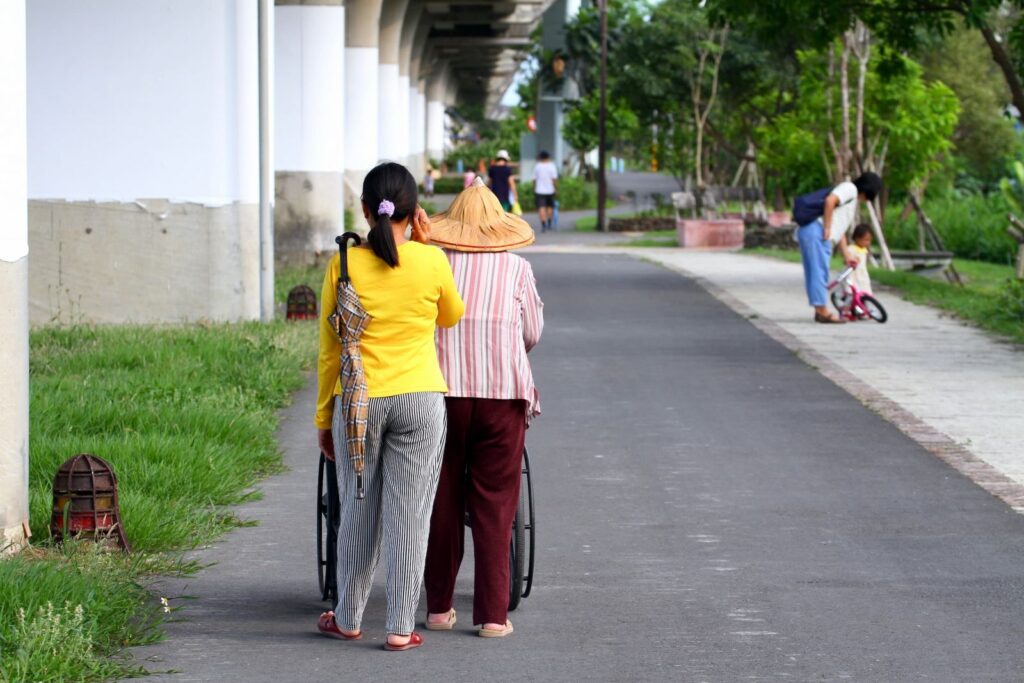
Header image “The presence of migrant workers in Taiwan’s elderly care system” from EuroView is free to use.
Reconfiguring Care Through Technology: Digital Care Circulation Among Migrant Care Workers
Taiwan officially entered the stage of an “aged society” in 2018 and is projected to reach “super-aged” status in 2025. As a result of this rapid demographic aging, the demand for long-term eldercare has substantially increased, leading both public and private institutions to rely heavily on Southeast Asian migrant women who are primarily from Vietnam, Indonesia, and the Philippines, as the backbone of the care workforce (Ministry of Labor, 2022). They provide around-the-clock assistance to the elderly in private households and care institutions, often under precarious working and living conditions (Liang, 2021). Despite their indispensable contribution to an ageing society, they shoulder heavy workloads, emotional strain, and profound social isolation due to language barriers and their migrant status.
Beyond their formal caregiving roles in Taiwan, these women also perform emotional and moral care within their own families across borders. To understand how care, affection, and moral responsibility continue to circulate across distance, this study draws upon the concept of care circulation (Baldassar & Merla, 2014), which emphasizes the multidirectional and reciprocal nature of care within transnational families. It recognizes that emotional, moral, and material support flow both ways across borders. The care circulation framework conceptualizes childcare, eldercare, and domestic work as transnational exchanges within migrant families, highlighting how they organize diverse caregiving arrangements, such as remote and cross-border parenting, to sustain family well-being. In the digital era, these circulations are increasingly mediated by technological infrastructures rather than physical presence or tangible exchange. As Madianou and Miller (2013) suggest, communication technologies now constitute a form of “polymedia”, enabling migrants to navigate emotional and social relationships through multiple interconnected media depending on context, affect, and social expectation.
ICTs have emerged as crucial tools for maintaining transnational ties. Through smartphones, messaging apps, and social media platforms, migrant caregivers sustain emotional and moral connections with their families across borders. It enables migrant family members to sustain parenting and eldercare across distance through continuous virtual co-presence (Aguila, 2009). It enables migrant parents, particularly mothers, who can sustain their parenting roles across distance through daily “check-ins” and “monitoring” of children’s routines (Chib et al., 2014). Such digital co-presence combines practical supervision, including homework and health follow-ups, with emotional support that nurtures affection and maintains parental bonds (Madianou, 2012). Besides, they facilitate practical support, such as monitoring elderly parents’ health and coordinating care, and foster new forms of filial piety through frequent video or voice contact instead of in-person visits (Baldassar, 2016; Ahlin, 2018). Visual technologies further enhance emotional closeness by allowing migrants to observe daily life and non-verbal cues in real time (Madianou, 2012). Beyond sustaining parenting and caregiving, ICTs also alleviate migrants’ emotional distress by reducing feelings of loneliness and isolation while fostering belonging, adaptation, and positive self-identity in the host society (Harney, 2013; Lin & Sun, 2010). Social media platforms such as Facebook further enhance happiness and satisfaction by sustaining connections with left-behind family and friends (Gonzalez & Katz, 2016).
Building on these perspectives, this article conceptualizes digital care circulation as the technologically mediated flow of care, emotion, and moral obligation between migrant care workers and their transnational families. This approach highlights ICTs not merely as channels of communication but as infrastructures of care that sustain intergenerational moral bonds and solidarity in real time. Digital media expand the spatial and temporal reach of care work, allowing migrant care workers to remain emotionally present despite physical absence. At the same time, these mediated connections expose the paradoxes of transnational family life; they soothe emotional pain while reproducing new forms of dependency and tension. By centering on digital care circulation, the article argues that technology is reshaping both the practice and meaning of care in contexts of migration. Screens become spaces where affection, surveillance, and moral responsibility intersect, sites through which migrant care workers reassert familial roles and moral identities despite spatial separation.
Settings
This qualitative study explores how Vietnamese migrant female care workers in Taiwan use ICTs to sustain family connections and cope with migration-related stress. Data were collected through semi-structured, in-depth interviews with eleven Vietnamese women currently employed in nursing homes. Participants were recruited using snowball sampling, including four in Hualien, two in Taipei, and five in Kaohsiung. They ranged in age from 32 to 53, were all married, and had husbands and children residing in Vietnam. Their duration of employment in Taiwan ranged from five to fourteen years.
Each interview lasted between 60 and 90 minutes and was conducted in Vietnamese, the native language shared by both participants and the two authors. All participants provided verbal informed consent prior to participation and were assured of anonymity. Pseudonyms are used throughout the quotations and analysis.
All interviews were transcribed verbatim and analyzed thematically. The authors first familiarized themselves with the data through repeated readings, generated initial inductive codes, and collaboratively identified overarching themes through iterative discussion. The entire analytic process was conducted in Vietnamese to preserve cultural nuance and interpretive depth before key excerpts and findings were translated into English for writing.
Digital Connectivity as Emotional Care Circulation
Reconstructing Presence at a Distance
For many participants, digital technology is not merely a communication tool but also a means of recreating presence and togetherness. Through daily video calls, they reenact family rituals, including sharing meals, helping children with homework, and chatting about household matters, as if they were still living under the same roof. These practices transform ICTs into a form of care at a distance, sustaining the moral and emotional bonds of family life.
Now that there’s a group call mode, we can all talk together; whoever wants to join can just join in. Talking all at once is really fun…Sometimes when I call, there’s nothing to say, but I just turn it on to watch the whole family eating. When I see them, I feel happy too. (Nhan)
These digital rituals help sustain emotional reciprocity and reinforce women’s identities as mothers and wives. The online practice of motherhood becomes a means for women to resist their social invisibility, as both isolated workers and distant mothers. For Nhan, the shared mealtime on screen is not merely a conversation but an act of reaffirming her place within the family.
Beyond performing motherhood through daily video calls, many migrant women also sustain their filial role as daughters by checking in with their elderly parents in Vietnam. For instance, Bong explained, “I call every day, I talk to my kids and also to my parents. My parents are already 70, but they still work in the field”. These conversations, though ordinary, signify a form of transnational filial piety. Similarly, Nhan described “talking every day, asking whether they [her parents] are sick or healthy, makes me feel close even though I can’t physically be there”. Such digital rituals of care illustrate how migrant women continue to be daughters across borders, enacting emotional and moral responsibilities through everyday digital connections.
Furthermore, ICTs enable them to continue performing their daily caregiving responsibilities. Many participants reported helping their children with homework, teaching them, or managing household expenses through their phones. In this sense, digital caregiving has become a way of doing family in the context of physical separation.
I told her boyfriend that I was working far away. If you two love each other, then get to know each other, but don’t be more than friends. Don’t get pregnant first. At the very least, you have to wait until I come back so I can let you get married. (Bong)
Such exchanges transform the digital space into a site of both compassion and moral authority, where the emotional and ethical dimensions of motherhood are continuously circulated. This reflects the notion of care as a moral practice, wherein acts of connection allow migrants to assert responsibility and dignity despite their physical absence.
Emotional Coping and Resilience
Digital connection also offers welcome relief amid the otherwise closed and isolating environment of nursing homes. Many women reported that simply hearing the voices of their loved ones gives them the strength to endure their demanding work.
Now, I call every day. I feel very close to my family, it’s just that I can’t hug them or eat together. Every day we talk and ask about each other, and I feel secure, unlike in the past when we couldn’t see one another. So now, modern technology really helps me feel safe and at ease while working here. (Thoa)
These practices transform digital communication into an emotional coping mechanism that converts nostalgia into motivation. Within the care circulation framework, this represents a two-way flow of emotions – mothers send care while receiving love and encouragement in return, the energy that sustains them in their daily lives. As Hoa expressed it succinctly, “Technology is so advanced now, that’s why my family takes care of me through phone calls…I send care back home through money for my children’s education and to support my elderly parents.”
Digital technology thus forms an effective infrastructure that sustains kinship across borders. The flow of care is not linear but reciprocal; comfort is both given and received through every call and message.
The Ambivalence of Digital Care
Guilt and Powerlessness
Along with the comfort it provides, digital care also exposes migrants to painful realities at home that they cannot physically intervene in. Many described feelings of guilt and helplessness when they saw how much their families missed them through the screen, the longing in their parents’ and children’s faces reminded them of their absence and deepened their sense of responsibility.
Even though I call every day, I still miss home sometimes. My husband also told me to come back because our child lacks a mother’s love. So I thought I should work for a few more years and then go home to take care of the child. It would be such a pity for the child to be apart from me for so long. (Hoa)
The immediacy of digital images, while easing these women’s sense of longing, also renders their pain more tangible. ICTs create what has been described as presence in absence, yet for migrant mothers, this very presence can become a burden. Moral expectations of care collide with lived realities that they cannot physically be with their loved ones, resulting in a profound sense of moral dissonance.
Moral Burdens of Transnational Motherhood
Digital channels also reinforce the moral dimension of motherhood, where emotional restraint becomes a way of caring. Many women said they never shared their sadness with their children for fear of worrying them. Instead, they tried to appear cheerful during every call.
Many times when I’m sad or have problems here, I don’t tell my family when I call because I’m afraid they’ll hear it in my voice and worry. So I just tell them happy things and keep the sad ones to myself. (Tran)
This example illustrates that caregiving is not merely an action but also a form of emotional self-control. The women perform a labor of love, suppressing their sadness to preserve the family’s emotional stability. Such endurance reflects a gendered expectation that women should embody patience, sacrifice, and emotional strength in the face of hardship.
Conversely, families in Vietnam often conceal distressing news or difficulties from the migrant women so that they can focus on their work abroad. This reciprocal act of emotional protection illustrates the bidirectional nature of care circulation, in which both sides manage emotions to safeguard each other’s well-being across distance. As Hoa shared:
When my sister passed away, my whole family hid it from me; no one told me. I only found out ten days later. (Hoa)
It can be seen that digital technology enables family members to be present in each other’s lives, yet this presence involves not only sharing but also concealing. Within the transnational flow of emotions, both the migrant women and their families in Vietnam learn to hide their sorrow, the mothers suppress their fatigue to reassure their children, while parents and children at home conceal their own hardships so that the women can focus on their work abroad. This mutual emotional restraint reveals that care circulation is not only about the exchange of affection or material support but also about the negotiation of emotions, in which silence and concealment become forms of care themselves.
Discussion and Conclusion
The study found that ICTs have become the emotional and moral infrastructure of transnational family life among migrant care workers in Taiwan. Through video calls, messaging apps, and social media, these women sustain a sense of presence and connection with their families despite physical separation. However, their experiences also reveal the paradoxes of what this study terms digital care circulation, that is, the movement of emotions, responsibilities, and moral obligations through technological channels that both connect and constrain them.
Drawing on the theoretical framework of care circulation (Baldassar & Merla, 2014), this study demonstrates that care does not flow in one direction from migrant to family, but rather through multiple emotional, temporal, and technological layers. ICTs enable new forms of distance care (Baldassar, 2016), where everyday communication becomes an expression of love, responsibility, and resilience. Video calls and online chats act as a form of co-presence (Aguila, 2009), through which these women reaffirm their caring role and moral standing within the family. Migrant women not only perform motherhood through the daily monitoring of their children’s habits, physical supervision, and the maintenance of close relationships (Chib et al., 2014; Madianou, 2012), but also fulfill filial duties from a distance by inquiring about their parents’ health through phone calls (Baldassar, 2016; Ahlin, 2018).
However, technology not only connects but also reproduces emotional strain and moral burden. In line with Madianou and Miller’s (2013) concept of polymedia, digital communication is never neutral; it is always embedded in moral expectations and gendered hierarchies. The women’s narratives reveal that being “always available” reinforces the self-sacrificing image of motherhood who is cheerful, caring, and emotionally resilient. For many, however, ICTs also serve as an outlet for emotional release (Harney, 2013; Lin & Sun, 2010), allowing them to unwind after exhausting workdays by connecting with loved ones. The phone screen thus becomes both a bridge of connection and a site of emotional weight. It offers comfort through the visibility of loved ones, yet it also intensifies guilt when women witness suffering they cannot alleviate. In this light, digital care emerges as a contradictory practice, both healing and wounding.
In sum, digital care circulation reveals the paradox of transnational caregiving. On the one hand, ICTs enable these women to demonstrate resilience and maintain family cohesion even in isolation. On the other hand, they deepen the asymmetries of cross-border care labor, reminding them of the moral weight of distance and the impossibility of achieving full presence. Digital technology thus both democratizes care and disciplines emotion; It expands the possibilities for connection while simultaneously demanding the continuous management of feelings and the performance of motherhood.
This study contributes to the scholarship on migration and care by conceptualizing digital communication as a form of transnational caregiving that is both transformative and contradictory. By extending the concept of care circulation into digital spaces, the study demonstrates that care today is not only a material or financial act but also an emotional labor mediated by technology. For Vietnamese and other Southeast Asian migrant women in Taiwan, ICTs function not merely as tools of connection but as spaces for negotiating identity, responsibility, and belonging. At the same time, they reflect and reproduce global inequalities and gendered burdens within the contemporary landscape of migration.
AI Use Disclosure Statement
This article was proofread and edited using AI-assisted tools (ChatGPT by OpenAI) to improve clarity, grammar, and academic style.
References
Aguila, A.P.N. (2009). Living long-distance relationships through computer-mediated communication. Social Science Diliman, 5(1-2), 83-106.
Ahlin, T. (2018). Only near is dear? Doing elderly care with everyday ICTs in Indian transnational families. Medical Anthropology Quarterly, 32(1), 85-102.
Baldassar, L. (2016). De‐demonizing distance in mobile family lives: co‐presence, care circulation and polymedia as vibrant matter. Global Networks, 16(2), 145-163.
Baldassar, L., & Merla, L. (Eds.). (2014). Transnational families, migration and the circulation of care: Understanding mobility and absence in family life. Routledge.
Chib, A., Malik, S., Aricat, R. G., & Kadir, S. Z. (2014). Migrant mothering and mobile phones: Negotiations of transnational identity. Mobile Media & Communication, 2(1), 73-93.
Gonzalez, C., & Katz, V. S. (2016). Transnational family communication as a driver of technology adoption. International Journal of Communication, 10, 21.
Harney, N. (2013). Precarity, affect and problem solving with mobile phones by asylum seekers, refugees and migrants in Naples, Italy. Journal of Refugee Studies, 26(4), 541-557.
Liang, L. F. (2021). Everyday vulnerability: Work and health experiences of live-in migrant care workers in Taiwan. In The Global Old Age Care Industry: Tapping into migrants for tackling the old age care crisis (pp. 219-242). Singapore: Springer Singapore.
Lin, T. T. C., & Sun, S. H. L. (2010). Connection as a form of resisting control: Mobile phone usage of foreign domestic workers in Singapore. Media Asia: An Asian Communication Quarterly, 37(4), 183-214.
Madianou, M. (2012). Migration and the accentuated ambivalence of motherhood: The role of ICTs in Filipino transnational families. Global Networks, 12(3), 277-295.
Madianou, M., & Miller, D. (2013). Migration and new media: Transnational families and polymedia. Routledge.
Ministry of Labor, Taiwan. (2022). Monthly bulletin of labor statistics.
